
Japanese Online Shopping from Overseas
You can shop at Japanese online stores from overseas in three main ways: direct international shipping, proxy buying, or package forwarding. The workable route depends on whether the store accepts your checkout details and destination, whether the item is eligible to ship, and how payment, import, delivery, and return conditions apply to that order.

Choose the ordering route that matches the transaction
Start with the merchant purchase, then check who receives the parcel in Japan and who arranges the international leg. No route overrides item, carrier, destination, import, or return restrictions.
-
Can the Japanese store accept your checkout details and ship this item to your overseas destination?
Yes Direct international shipping fits: you buy from the merchant and the merchant or its fulfilment arrangement sends the eligible order abroad.
-
If direct international delivery is unavailable, can you still complete the merchant purchase using a Japanese delivery address?
Yes Package forwarding may fit: you place the order, the forwarder receives it in Japan, and the forwarder arranges onward international shipment.
-
If you cannot complete the merchant purchase yourself, will an intermediary accept the item and destination?
Yes Proxy buying may fit: the intermediary purchases from the Japanese seller on your behalf, typically handles domestic receipt in Japan, and arranges the onward route under its service rules.
- Merchant access
- Does the store accept the required customer, address, and order conditions?
- Payment
- Can the transaction be completed with an accepted payment method and details?
- Shipping eligibility
- Is the item accepted by the intended service for the parcel's size, weight, and characteristics?
- Destination
- Does the route serve the destination and satisfy applicable import conditions?
- Total cost
- Compare item, service, domestic and international shipping, payment/FX, and import charges that actually apply.
- After purchase
- Check tracking responsibility and the return/refund policy for the party that handled the transaction.
Decision rule: passing one check does not establish the others. Confirm the complete route for the specific store, item, service, and destination before ordering.
A successful overseas purchase is therefore a chain of compatible conditions: purchase eligibility → checkout and payment → fulfilment → destination import processing → delivery and any return handling. The sections below explain each stage and the differences between the three ordering methods.
Table of Contents
How Japanese Online Shopping Works for International Shoppers
The overseas ordering transaction generally moves from checking store and item eligibility to checkout or an intermediary route, then to fulfilment and international delivery.
The exact route depends on whether the Japanese online store accepts the overseas shopper's destination, address, payment, and intended shipping method.
The illustration establishes the cross-border context between the Japanese store, overseas shopper, and international fulfilment without implying that every order follows the same route.

Store policy establishes whether an overseas sale can proceed directly, while item and destination eligibility determine whether the intended shipping arrangement is available.
At checkout, the store's accepted address and payment conditions determine whether the shopper can complete the purchase directly or needs a different ordering route.
Fulfilment then follows the available shipping method, with the parcel moving from dispatch toward import processing and destination delivery.
The four stages below summarize the transaction at overview level rather than replacing the detailed ordering process.
- Check the Japanese online store, item, and destination for overseas-order eligibility.
- Complete checkout directly when the required address and payment conditions are accepted, or use an intermediary route when direct ordering conditions are not met.
- Move the fulfilled order into the available international shipping method for cross-border dispatch.
- Complete import processing and destination delivery under the conditions that apply to the shipment.
For example, an eligible order can proceed directly when the Japanese online store accepts the shopper's checkout details and provides international delivery to the destination.
If the store cannot accept the overseas address or another direct-order condition is not satisfied, an intermediary may change who completes the purchase or receives the parcel before international fulfilment.
The exact ordering route therefore changes when the conditions for direct ordering are not met.
Barriers That Affect Overseas Orders from Japanese Stores
A barrier to an overseas order is a condition that can prevent an overseas shopper from completing the purchase, moving the order into international shipping, or receiving it at the destination.
The restriction may arise from store policy, checkout requirements, payment acceptance, shipping availability, an item restriction, a carrier, or destination rules.
The illustration shows these barriers as possible failure points across the transaction rather than as a single rule that applies to every order.

The barrier classes are separated by where control sits in the overseas transaction.
Merchant or store-policy restrictions can affect whether an overseas sale is accepted before checkout, while checkout or payment conditions can stop an otherwise eligible purchase from being submitted or paid.
Shipping or carrier restrictions affect whether the parcel can use the intended route, while item or destination conditions affect whether that particular shipment is eligible to move or be received.
The grouped list below identifies each class and one typical practical implication.
- Merchant or store policy: the Japanese store may not accept an overseas sale or the requested destination under its sales policy.
- Checkout or payment: required address details or payment acceptance conditions may prevent checkout from being completed.
- Shipping or carrier: the intended destination or shipping route may not be available through the relevant carrier service.
- Item or destination conditions: an item restriction or destination rule may prevent the item from using the intended shipping route or being received under the applicable conditions.
A restriction created by store policy is therefore different from a limit imposed by a payment system, carrier service, item condition, or destination rule.
Because these controls apply at different stages, a failed overseas order can have different causes depending on whether the transaction stops at purchase, checkout, shipment, or destination receipt.
International Shipping Availability and Destination Limits
International shipping availability depends on the combined conditions of the Japanese store, item eligibility, carrier service, and supported destination rather than on a single yes-or-no store setting.
An overseas shopper therefore needs both an eligible item and a fulfilment route that serves the intended destination under the applicable store and carrier conditions.
The illustration shows how these eligibility conditions interact without implying that one destination or service is available for every order.

A Japanese store may offer international delivery only to destinations covered by its sales policy or an available carrier service, while the item must also meet the shipping eligibility conditions for the selected route.
Parcel limits, including size or weight restrictions where a service applies them, can further determine whether that shipment can use the intended method.
These checks jointly determine whether shipping can proceed and separate store-level coverage from shipment-level constraints.
Support for one destination or item does not establish support for all destinations or items.
- Store coverage: check whether the Japanese store accepts overseas orders for the intended destination.
- Destination and carrier service: check whether an available carrier service covers the supported destination for that shipment.
- Item eligibility: check whether the item can use the intended international shipping route under the applicable store and carrier conditions.
- Parcel and service limits: check whether any applicable parcel limits, such as size or weight conditions, are compatible with the selected service.
Checkout, Address, and Payment Requirements
Japanese website checkout requirements are store-specific conditions that determine whether an overseas shopper can submit the required delivery address, contact details, and payment information and complete checkout.
A store requirement may concern how customer information must be entered, which payment method can be selected, or whether that payment is accepted under the store's processing conditions.
The illustration shows these checkout prerequisites as separate from later shipping or import eligibility.

The main criteria follow the checkout form from customer and address information to payment.
If the shopper can satisfy the required address and contact fields, those parts of checkout can proceed; if a required field cannot be supplied in an accepted form, submission may be blocked.
A supported payment method must also be available to the shopper, while payment acceptance can remain conditional on the store, payment processor, method, issuer, and transaction details.
Successful checkout establishes that the store's form and payment conditions were accepted for that transaction, but it does not by itself establish later shipping or import eligibility.
- Delivery address format: the overseas shopper must be able to enter the delivery address in the format accepted by that store; an incompatible required field can prevent checkout submission.
- Contact details: required customer details must be supplied in the format accepted by the checkout; missing or invalid required details can block submission.
- Supported payment methods: the shopper needs a payment method offered by that checkout; a method that is not available cannot be selected for the order.
- Payment acceptance conditions: selecting a supported payment method does not guarantee acceptance, because the transaction may still be accepted or declined according to the applicable store, processor, issuer, method, and transaction conditions.
Item and Shipping Restrictions
An item's characteristics can change its eligibility for international shipping and which shipping route is available from Japan to an overseas destination.
The restriction classes below show how item type, dimensions, weight, controlled characteristics, carrier conditions, and destination eligibility can affect the route available for a particular shipment.
The illustration maps these item characteristics to possible shipping consequences without implying a universal restriction.
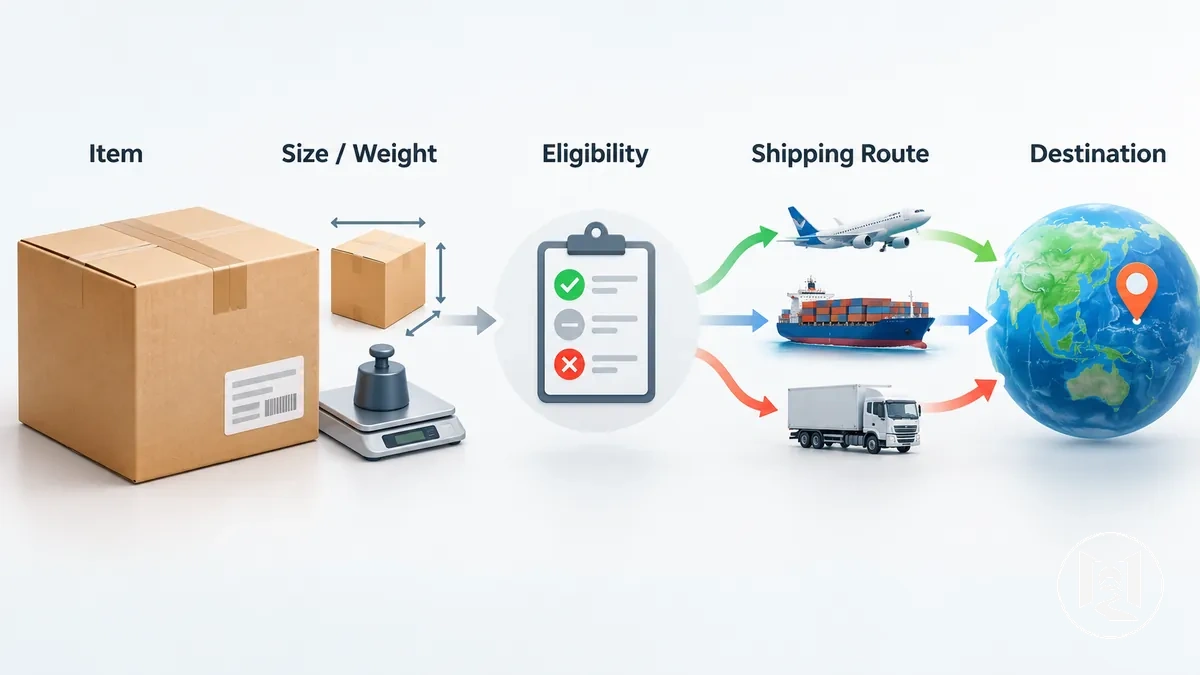
- Item type: an item category that a merchant, carrier, or service does not accept under the intended conditions may require another eligible shipping route or may be unavailable for that route.
- Hazardous or controlled characteristics: a restricted item that is accepted only under specific handling or transport conditions may have fewer eligible carrier services or shipping routes.
- Dimensions and weight: if the packed parcel does not meet the size or weight conditions of a particular service, that service may not be available even when the item itself is otherwise eligible.
- Carrier and destination limits: an item may be eligible for one carrier, service, or destination configuration but not another, so shipping eligibility remains specific to the intended route and destination conditions.
These restrictions determine whether a particular item can use the intended shipping route rather than establishing a universal rule for all products.
Merchant and carrier restrictions apply to whether and how the item can be transported, while destination-country import rules apply separately to whether the shipment may enter or be received under that destination's requirements.
A restricted item can therefore face a transport limitation even when destination import conditions are otherwise satisfied, or an import limitation even when a carrier would otherwise accept the shipment.
Shipping restrictions and destination import restrictions remain separate conditions even when both affect the same parcel.
Ways to Buy from Japanese Online Stores from Overseas
Direct international shipping, proxy buying, and package forwarding differ mainly in who acts as the purchaser, which address is used, and who carries international shipping responsibility.
With direct international shipping, the overseas shopper purchases from the Japanese store for delivery abroad; with proxy buying, an intermediary places the purchase; with package forwarding, the shopper purchases from the merchant while using a Japanese address for domestic receipt.
The illustration shows these responsibility paths without ranking one method above another.
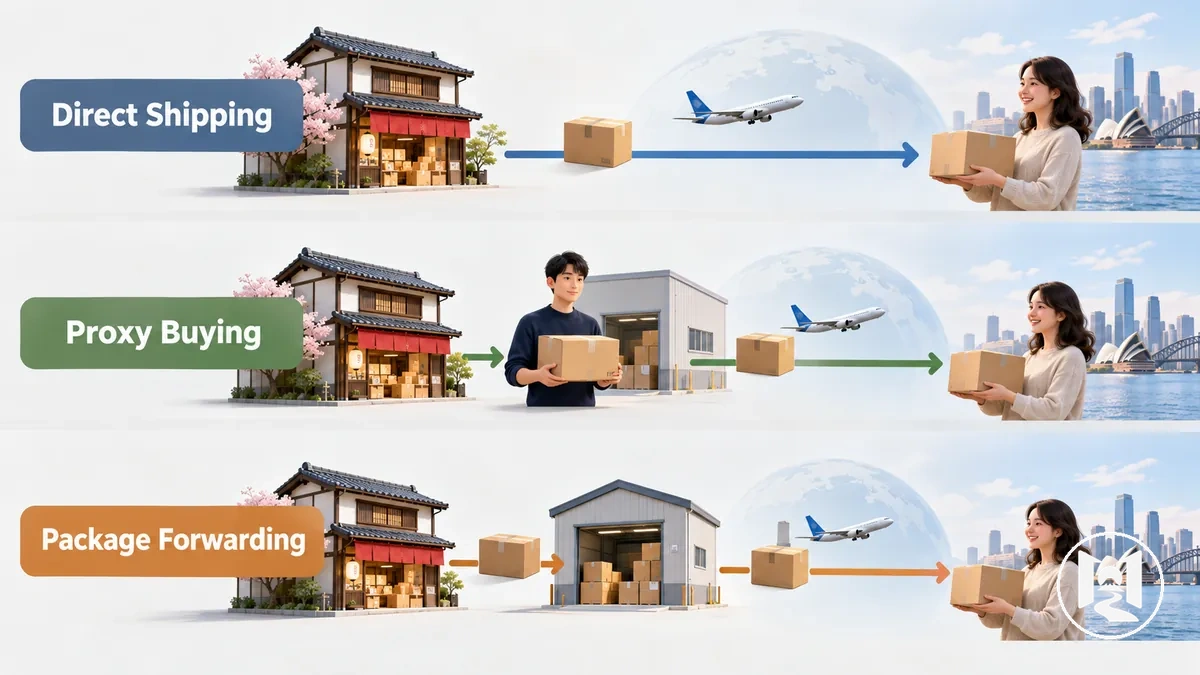
The methods can be compared using the same criteria: purchaser role, address requirement, merchant interaction, and responsibility for arranging international shipment.
These criteria distinguish whether the shopper or an intermediary places the order, whether an overseas or Japanese address is used for merchant fulfilment, and who receives the parcel in Japan when domestic receipt is part of the route.
The comparison organizes those structural differences and the conditions that affect suitability rather than ranking services.
| Method | Who places the purchase | Address requirement | Merchant interaction | International shipping responsibility | Suitable context |
|---|---|---|---|---|---|
| Direct international shipping | The overseas shopper | An overseas delivery address accepted by the Japanese store for the order | The shopper interacts directly with the merchant | The store or its fulfilment arrangement sends the eligible order internationally | When the store accepts the shopper's checkout details, item, destination, and international fulfilment conditions |
| Proxy buying | A proxy or intermediary purchases on the shopper's behalf | The intermediary handles the Japanese purchase and domestic receipt address required for its ordering route | The intermediary conducts the purchase interaction with the merchant | The proxy or its fulfilment arrangement organizes onward international shipment | When the overseas shopper cannot complete the merchant purchase directly and the intermediary accepts the item and destination |
| Package forwarding | The overseas shopper | A Japanese address supplied by the forwarding service is used for domestic delivery | The shopper interacts directly with the merchant for the purchase | The forwarder receives the parcel in Japan and arranges onward international shipment | When the shopper can complete the merchant's purchase requirements but needs domestic receipt in Japan before international forwarding |
Suitability depends on store access, checkout requirements, item eligibility, available fulfilment conditions, and the overseas shopper's situation.
Direct international shipping keeps purchase and international fulfilment with the merchant or its fulfilment route, proxy buying changes the purchaser and merchant-interaction role, and package forwarding changes the domestic receiving and onward-shipping role.
These responsibility differences define the ordering routes without establishing a universal winner.
Direct International Shipping
Direct international shipping is an ordering method in which the Japanese store accepts the overseas order and arranges shipment to the shopper's foreign destination without a purchasing intermediary.
The shopper purchases from the store directly, while the store or its fulfilment arrangement handles the international dispatch for an eligible order.
The Japanese store must accept overseas orders, and the destination must fall within the supported delivery area for the available shipping arrangement.
The item must meet the relevant shipping eligibility conditions for that destination and service.
At checkout, the shopper must also be able to provide an accepted delivery address and satisfy the store's payment acceptance requirements.
Direct international shipping is therefore available only when the store, item, destination, delivery address, and payment conditions required for that order align.
Proxy Buying
Proxy buying is an intermediary purchasing method in which a Japan-based service or agent buys from the Japanese seller on the shopper's behalf.
The shopper provides a purchase request and the payment required under the proxy's service rules, while the intermediary performs the merchant purchase rather than the shopper buying directly from the seller.
The intermediary places the order with the Japanese seller and typically handles domestic receipt of the parcel before it moves into a later international shipment.
Seller eligibility, item eligibility, payment arrangements, and onward-shipping conditions can vary according to the proxy's service rules and the transaction involved.
The proxy therefore takes responsibility for the original merchant purchase and domestic receiving role, subject to those conditions.
This distinguishes proxy buying from package forwarding, where the shopper places the original merchant purchase and the forwarding service primarily provides domestic receipt and onward fulfilment.
Package Forwarding
Package forwarding is a method in which the shopper generally completes the merchant purchase from the Japanese store while using a Japanese address supplied by a forwarding service for domestic delivery.
The forwarder then handles parcel receipt in Japan and supports the later international dispatch to the shopper's overseas destination.
The shopper remains responsible for completing the merchant purchase and satisfying the store's checkout conditions, while the Japanese address serves as the domestic delivery point for the order.
After domestic delivery, the forwarding service receives the parcel and arranges international dispatch according to its service rules, item eligibility, and supported destination conditions.
Package forwarding therefore differs from proxy buying because the shopper generally remains the original merchant purchaser rather than assigning that purchase to an intermediary.
Using a forwarding address does not automatically remove store restrictions, item restrictions, or destination eligibility requirements.
Costs and Import Charges on Orders from Japan
The item price may be only one part of the total cost of an order from Japan.
Comparing ordering methods therefore requires comparing the complete cost path rather than only the merchant's item price or a single shipping quote.
Some purchase and transport costs can be known before dispatch, while destination-dependent import charges may require separate verification under the conditions that apply to the shipment.
Total Order Cost and Additional Charges
Total order cost is the combined amount of the item price and every additional charge that applies to a particular overseas order from Japan.
The final amount can therefore include shipping, service, payment, currency conversion, or import-related costs, but variable charges apply only when the relevant ordering method, payment condition, shipment, or destination triggers them.
The table separates each cost component by when it may apply, what can change its amount, and how it contributes to the final amount.
It keeps optional costs conditional rather than assuming that every order includes domestic shipping, an intermediary fee, a forwarding fee, a payment charge, currency conversion, or an import charge.
No universal total can be stated because the applicable components and their amounts depend on the specific transaction, service conditions, shipment, and destination.
| Cost component | When it may apply | What can change the amount | Effect on total cost |
|---|---|---|---|
| Item price | Applies to the merchandise purchased from the Japanese seller | Merchant price, selected item or variant, and quantity | Forms the purchase-price component of the final amount |
| Domestic shipping | May apply when the merchant sends the order to a Japanese address before international shipment | Merchant shipping conditions, domestic route, and parcel characteristics | Adds a domestic transport cost when charged |
| Intermediary or forwarding fee | May apply when a proxy intermediary or package-forwarding service participates in the order | Service rules and the services used for that transaction | Adds an intermediary fee or forwarding fee when charged |
| International shipping | Applies when a paid shipping service carries the parcel from Japan to the overseas destination | Destination, shipping route, service conditions, parcel dimensions, and weight | Adds the international transport cost to the final amount |
| Payment or currency conversion | May apply when the selected payment method carries a payment charge or requires currency conversion | Payment method, payment provider conditions, and the applicable currency conversion terms | Adds the applicable payment charge or conversion cost |
| Import charge | May apply when destination customs rules assess duty, tax, or another import-related charge | Destination rules, item classification, declared or assessed value, and other applicable import conditions | Adds a destination-dependent amount when assessed |
Two orders with the same item price can therefore reach different final amounts when their ordering methods, domestic handling, international shipping conditions, payment arrangements, or destinations differ.
Purchase and shipping charges may be identifiable during the order and fulfilment process, while an import charge remains dependent on the destination conditions that apply to the shipment.
Customs, Duties, and Import Processing
A Japan-origin parcel may enter the destination country's import processing system before final delivery.
Customs treatment is governed by the destination country's rules, which determine whether the shipment requires assessment, duty or tax treatment, additional information, or other clearance actions before release.
The general import-processing sequence can vary by destination country and carrier, so not every shipment passes through each stage in the same way.
Customs processing uses shipment information submitted through a declaration or carrier documentation, including the item description and declared value.
Destination rules then determine whether assessment, payment or information requests, and release actions are relevant before delivery.
- Declaration or submission: shipment information, including the declared item and declared value, is submitted for import processing through the applicable carrier or customs process.
- Assessment where applicable: customs may assess the shipment under destination-country rules to determine whether duty, tax, or another import requirement applies.
- Payment or information request where applicable: the shipment may require payment of an assessed charge or additional information or documentation before processing can continue.
- Release to delivery: once the applicable import requirements are satisfied, the shipment can be released from customs processing and continue toward local delivery.
Origin and transport side
Merchant, export, and carrier restrictions determine whether an item can leave Japan and use the intended transport route.
Destination side
Destination-country import rules determine entry, customs treatment, possible assessment, information requests, payment, and release before delivery.
Key distinction: these constraints are related but separate. A shipment can satisfy transport conditions and still face destination import requirements, and import processing can affect both charges and delivery timing.
International Delivery and Returns for Orders from Japan
The post-purchase stage for an order from Japan begins with international dispatch and continues through carrier handoff, tracking, delivery status, and any later return or refund need.
Delivery handling and return or refund handling are connected to the same transaction, but they are separate contexts with different responsibilities and conditions.
After international dispatch, a carrier handoff can change which party provides tracking updates and manages the shipment during the next part of the route.
Tracking visibility and delivery status can depend on the carrier, shipment stage, and available tracking system rather than guaranteeing a particular delivery outcome.
The ordering method also affects responsibility: the seller may remain the primary fulfilment contact for a direct order, while an intermediary may handle part of the post-purchase communication or shipment when it participated in the transaction.
A delivery issue therefore needs to be interpreted according to the shipment's current status and the responsibilities created by the ordering method.
Tracking and International Delivery
Tracking shows recorded shipment states, such as processing, movement, or a carrier handoff, but a tracking status does not guarantee an exact delivery time.
A carrier scan indicates that an event was recorded at a particular shipment stage rather than providing certainty about when the parcel will reach the recipient.
Status interpretation should follow the parcel's progression from international transport toward local delivery.
During a carrier handoff or customs processing, tracking visibility can temporarily depend on when the next carrier or facility records a new event, creating a visibility gap without establishing a delivery problem.
Scan frequency and delivery timing can vary with the carrier, route, customs processing, and local handoff.
The common status categories below therefore describe shipment states and cautious interpretations rather than guaranteed outcomes.
- International movement: an in-transit or movement-related carrier scan indicates that the shipment is progressing through the transport network, without establishing an exact arrival time.
- Customs processing: a customs-related tracking status indicates that the shipment is within an import-processing stage or associated handoff, but does not by itself show that a problem exists.
- Carrier handoff: a transfer between international and destination networks may be followed by a visibility gap until the receiving carrier records another scan.
- Local delivery: a local-delivery status indicates that the parcel has reached a destination-side delivery stage, while the next update depends on the local carrier's processing and scan events.
Returns and Refunds for Overseas Orders
Return and refund availability for an overseas order from Japan depends on the applicable return policy, return reason, timing, item condition, ordering method, and responsibility for the transaction.
These conditions determine both eligibility to return an item and how any approved refund may be handled.
The main criteria separate return eligibility from responsibility for communication, return shipping, and the refund path.
The seller or intermediary may require information or evidence appropriate to the return reason, while the item's condition and the policy's timing requirements can affect whether the request qualifies.
Return-shipping responsibility can also affect the cost or practical feasibility of sending an item back, and the refund path normally follows the party that processed the original purchase.
- Return policy: the applicable seller or intermediary policy determines whether the order is eligible for a return and which conditions apply.
- Return reason: the reason for the request can affect the evidence, explanation, or condition required before eligibility is determined.
- Timing: the request must fall within any timing conditions established by the applicable return policy.
- Item condition: the item's state can affect eligibility when the policy distinguishes between unused, opened, damaged, defective, or otherwise changed goods.
- Return shipping: responsibility for sending the item back can affect the cost and feasibility of an overseas return and depends on the applicable policy and return reason.
- Refund path: an approved refund may be processed through the seller for a direct purchase or through an intermediary when that intermediary originally handled the merchant purchase.
For a direct order, the shopper may communicate with the seller about the return and refund, while an intermediary-assisted order can place that communication or refund handling with the intermediary according to its role and policy.
Intermediary involvement therefore changes process ownership without guaranteeing return eligibility or a refund.