
Estimating the Total Landed Cost of an Online Order from Japan
Estimate the total landed cost by adding the item price to every applicable charge: Japanese domestic shipping, proxy or forwarding fees, international shipping, import duties, taxes or clearance, and currency or payment costs. Convert all amounts to one currency, use confirmed amounts where available, and keep provisional or unresolved charges visibly separate rather than assuming they are zero.
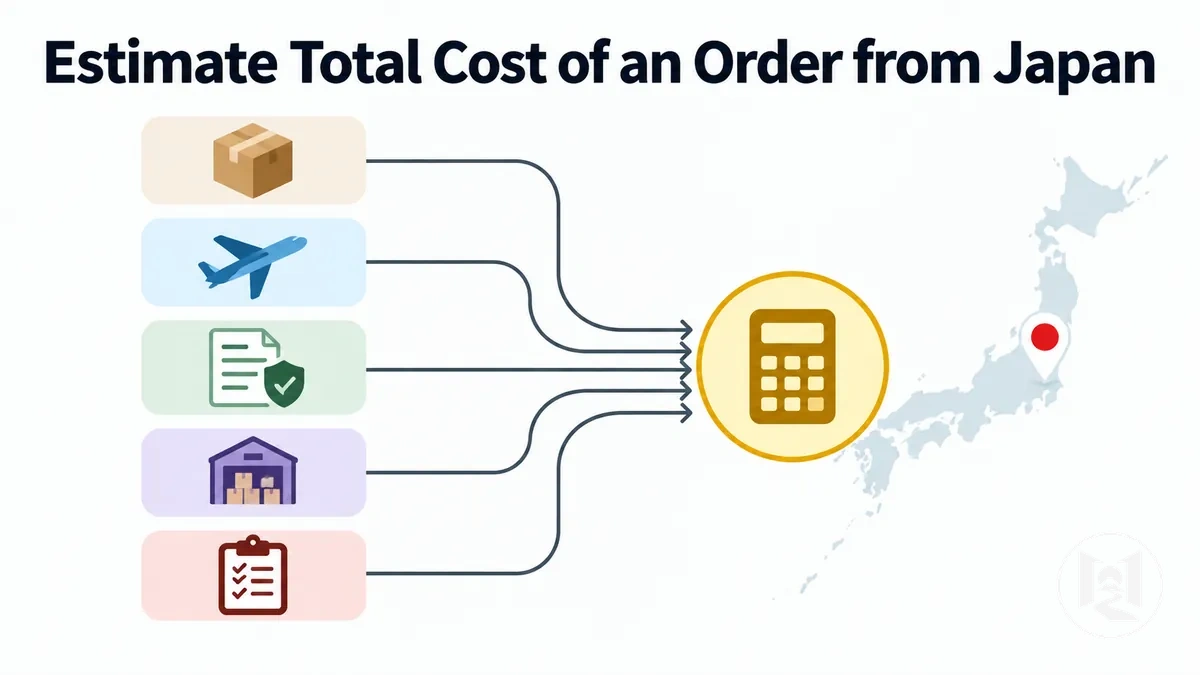
Landed-cost estimate worksheet
Enter each amount after expressing it in the same currency. The calculator adds the baseline costs and keeps import charges as a confirmed zero, a supported range, or an unresolved amount.
This worksheet does not fetch live exchange rates or determine customs treatment. Convert yen-denominated charges with a consistent reference rate first, and replace estimates with actual charges as they become known.
Some costs may be known at checkout, while international shipping can change after packing, import charges depend on the destination and shipment, and the settled home-currency amount can change with the payment provider's rate and fees. Keep the assumptions behind provisional values so the estimate can be recalculated as stronger order-specific information becomes available.
Table of Contents
What Makes Up the Total Cost of an Order from Japan
The total cost of an order from Japan includes the item price plus any applicable Japanese domestic shipping, service fees, international shipping, import charges, currency conversion, and payment fees.
Some cost components apply directly to the purchase, while others arise only when the seller, ordering method, destination, or payment arrangement requires them.
Together, the applicable components determine the amount that must be included in the order estimate.
An order can accumulate costs as it moves from the Japanese seller through domestic delivery, an intermediary when used, international transport, import processing, and payment or currency conversion.
The diagram shows how these stages can accumulate into one total, while the table separates each cost component by when it can arise, its typical charging basis, its certainty at the estimate stage, and its effect on the total cost.
This distinction keeps confirmed charges separate from amounts that remain estimated or conditional.

| Cost component | When it can arise | Typical charging basis | Certainty at estimate stage | Effect on total |
|---|---|---|---|---|
| Item price | When the purchase is placed with the Japanese seller | Seller price for the selected item or items, including applicable checkout adjustments | Usually known once the seller confirms the purchase price | Forms the base purchase amount |
| Japanese domestic shipping | When the seller charges for delivery to a Japanese address before export | Seller shipping terms, order conditions, and the domestic destination | Conditional; known when the seller provides the domestic delivery charge | Adds to the pre-export subtotal when charged separately |
| Service fees | When a proxy, forwarder, or other intermediary performs a paid service | The applicable order, item, transaction, package, handling, or optional-service basis | Conditional; known or estimable once the required intermediary services are identified | Adds intermediary charges to the total cost |
| International shipping | When the parcel is transported from Japan to the destination country | Parcel characteristics, destination, and selected shipping service | Often estimated until the packed parcel and shipping service are confirmed | Adds the overseas transport charge |
| Import charges | When destination-country rules impose applicable duties, taxes, clearance charges, or other import costs | Destination rules and the shipment's relevant characteristics and declared value | Conditional; the final amount may remain unconfirmed until the applicable import assessment is determined | Adds applicable destination-side charges |
| Currency conversion and payment fees | When payment requires currency conversion or the payment provider applies a transaction-related charge | The exchange rate and applicable payment-provider terms at the time of payment | Conditional; known or estimated according to the rate and payment terms used for the transaction | Changes the amount paid in the shopper's home currency or adds a payment charge |
Not every order includes every cost component, and some amounts become firm earlier than others.
A useful total-cost estimate therefore keeps confirmed charges separate from estimated or conditional charges until the remaining amounts are established.
Item Price and Japanese Domestic Shipping
The pre-export subtotal starts with the item price charged by the Japanese seller and may also include domestic shipping to a Japanese delivery address.
The item price should reflect seller-level discounts or taxes already included at checkout.
When the seller charges domestic delivery separately, that charge is added to the item price before the parcel leaves Japan.

- Charging basis
- Japanese domestic shipping may be charged per seller, per order, or according to a seller's free-shipping threshold.
- Included or separate
- Domestic delivery may already be included in the seller's checkout total; if it is charged separately, add that amount once.
- Decision rule
- Use the Japanese seller's stated order and delivery terms rather than assuming domestic shipping is free or fixed.
- Pre-export subtotal
- Item price + applicable separate Japanese domestic shipping gives the Japan-side purchase subtotal before later service, international shipping, import, and payment costs.
Proxy or Forwarding Service and Handling Fees
Proxy or forwarding service fees are conditional costs that apply only when the chosen ordering method uses an intermediary.
A proxy service may charge for purchasing or processing an order, while a forwarding service may charge for receiving, handling, or preparing a package.
The applicable handling fee or service fee depends on the intermediary actions actually used.

Intermediary charges can be assessed at different stages and on different units, so each applicable charge should be recorded separately in the cost estimate.
A fee may become known when the order is placed, an item is processed, a transaction is completed, a package is handled, or an optional service is selected.
These charging bases determine how the intermediary cost is added to the estimated total.
- Per order: a service fee may apply once to an order handled by the intermediary.
- Per item: a proxy service may assess a charge for each item it purchases or processes.
- Per transaction: a charge may apply to a specific purchase or payment transaction.
- Per package: a forwarding service may assess a handling fee when a package is received or prepared for onward shipment.
- Optional service: an extra charge applies only when a service such as repacking, inspection, or another supported handling action is selected.
Fee structures differ because proxy and forwarding methods involve different intermediary actions, so the planning task is to identify every applicable charge rather than assume one universal fee model.
Record those intermediary charges before combining them with later shipping and import costs.
International Shipping: Package Weight, Size, Destination, and Service
International shipping cost is mainly shaped by package weight, dimensional weight, parcel size, destination, and the selected shipping service.
A carrier quote can change when any of these parcel or route attributes changes, so the same item can produce a different shipping estimate after packing or under a different service level.
Actual weight and dimensional weight are different inputs to shipping pricing: actual weight is measured, while dimensional weight is calculated from parcel dimensions using the carrier or service formula. Where dimensional-weight pricing applies, use the chosen service's stated billable-weight rule rather than assuming one universal divisor.

Each attribute affects the shipping estimate under specific carrier and service conditions.
Greater actual weight can increase the quote when it raises billable weight, while larger dimensions can increase dimensional weight and may change which weight is used for pricing.
Destination can change the applicable route or service conditions, and the selected shipping service can increase or reduce the carrier quote according to the carrier's terms for that parcel and route.
| Shipping attribute | What changes | Possible cost implication |
|---|---|---|
| Actual package weight | The measured physical weight of the packed parcel | A higher actual weight can increase the quote when it raises the billable weight under the selected service rules |
| Dimensions and dimensional weight | The parcel's length, width, height, and resulting dimensional weight | Larger parcel dimensions can increase dimensional weight and may raise the quote when dimensional weight becomes the applicable billable weight |
| Destination | The delivery country, route, zone, and available services | A different destination can change the quote because routing and service conditions can differ |
| Shipping service | The selected service level and its conditions for the parcel and route | Changing the service level can increase or reduce the quote according to the applicable carrier terms |
The carrier quote may remain provisional until the parcel is fully packed and its final weight and dimensions are measured.
If those measurements differ from the estimate, the billable weight and revised shipping cost may also change.
Import Duties, Taxes, and Clearance Charges
Import duty, tax, and any clearance charge are conditional parts of landed cost because their application depends on the destination country and the imported item.
An order may therefore have no charge in a category, a known charge, an estimated allowance, or an unresolved amount until the relevant customs conditions are assessed.
These amounts should not be treated as one fixed percentage that applies to every shipment.
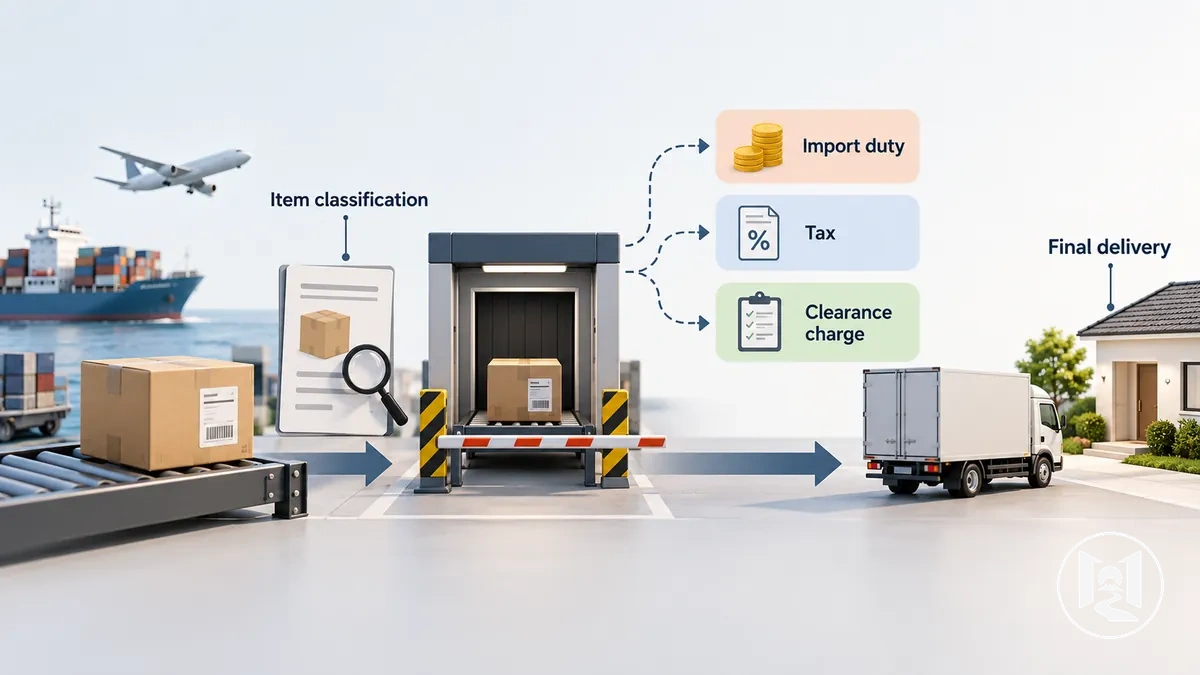
Import charges depend on destination-specific conditions such as item classification, customs value, applicable thresholds, and any carrier or broker handling involved in clearance.
Each condition can affect whether a conditional charge applies and how much it adds to the final landed cost.
Where a classification, customs value, threshold, or handling condition has not yet been confirmed, the corresponding import charge should remain estimated or unresolved rather than be assigned an unsupported rate.
- Destination country: local customs and tax rules determine which import charges and procedures may apply.
- Item classification: the classification assigned to the imported item can affect how an import duty or other customs rule is assessed.
- Customs value: the value used for customs assessment can affect the basis on which applicable duties or taxes are calculated.
- Threshold: a jurisdiction may apply a threshold or other condition that changes whether a particular charge applies, so the relevant current rule must be verified for the destination.
- Clearance handling: a carrier or broker may apply a separate clearance charge when its handling terms require one, adding that amount to the landed-cost estimate.
Estimating an allowance for possible import charges is different from determining the exact customs treatment of a specific item and destination.
Exact treatment may remain unresolved until the applicable destination rules, classification, customs value, threshold, and clearance conditions are confirmed.
Exchange-Rate Conversion and Payment Fees
A Japanese-yen order can produce a different home-currency total from a simple conversion because the effective rate at settlement and any payment charges may differ from the reference exchange rate used for planning.
The reference exchange rate provides an estimate for converting Japanese yen into the shopper's home currency, while the final settled amount depends on the rate and fees actually applied.
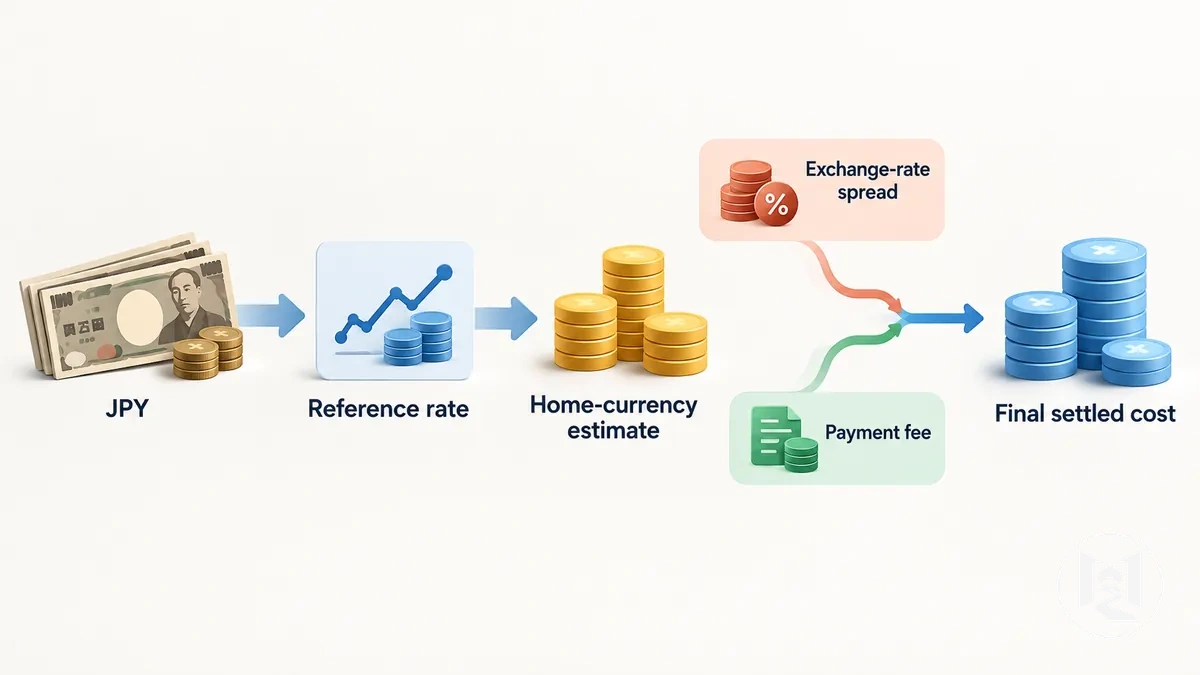
The underlying JPY charges can remain unchanged even when the home-currency total changes.
Each yen-denominated charge should be converted using the chosen planning rate, while provider-specific conversion cost and payment charges should be recorded separately rather than hidden inside one unexplained rate.
The effective rate may include an exchange-rate spread relative to the planning reference rate, while a foreign-transaction fee or payment fee may be applied separately at settlement.
- Reference exchange rate: converts the Japanese-yen subtotal into a planning estimate in the home currency without determining the eventual settlement rate.
- Effective rate: the conversion rate actually applied at settlement can differ from the planning reference rate and therefore change the home-currency amount.
- Exchange-rate spread: a provider-specific difference between the reference rate and the effective conversion rate can add to the conversion cost.
- Payment charges: a foreign-transaction fee or payment fee may be added separately when the provider's terms apply, increasing the final home-currency charge.
Separate Known Costs from Estimates and Conditional Charges
Each charge should be classified as a confirmed cost, estimated cost, or conditional charge before it is combined into the working total.
A confirmed cost is supported by an order-specific amount, while an estimated cost uses the best available quote or assumption but can still change.
A conditional charge applies only if a particular rule, threshold, service, or later event makes the charge relevant.
Keeping these certainty states separate makes uncertainty visible instead of presenting every value as final.
The certainty state depends on what is known and documented at the time of estimation.
An invoice, completed checkout amount, or applicable firm quote can support a confirmed cost, while a provisional quote or assumption supports an estimated cost until a firmer order-specific amount becomes available.
A charge remains conditional until the condition that creates it is established, and its treatment in the estimate should reflect whether an amount, range, or only the possibility of the charge is currently supported.
| Cost item | Certainty state | Order information available | How to treat it in the estimate |
|---|---|---|---|
| Item price | Confirmed when the applicable seller price is fixed for the order; estimated if the purchase amount is not yet final | Seller checkout amount, order confirmation, invoice, or other current purchase record | Use the verified amount when confirmed; otherwise retain the supported provisional amount and update it when the purchase is finalized |
| Domestic shipping | Confirmed when the seller provides the applicable charge; estimated or conditional when the amount depends on unresolved order conditions | Seller delivery quote, checkout charge, or stated shipping condition applicable to the order | Include the confirmed amount, use a supported estimate when provisional, or keep the charge visible as conditional until its triggering condition is known |
| Service fees | Confirmed when the applicable service fee is identified; conditional when a fee depends on an optional service, package event, or other unresolved requirement | Order-specific fee information or service terms showing which charge applies | Add confirmed fees directly and retain unresolved applicable fees as conditional rather than assuming zero |
| International shipping | Estimated when based on provisional parcel details; confirmed when the applicable carrier quote reflects the final shipment conditions | Shipping quote together with the parcel weight, dimensions, destination, and selected service on which it is based | Use the current quote as an estimated cost until the shipment conditions supporting a final quote are established |
| Import charges | Conditional or estimated until the relevant customs conditions and assessment are sufficiently known; confirmed only when the applicable amount is established | Destination rules, item and customs information, or an applicable customs or clearance assessment | Keep possible duties, taxes, and clearance charges visible as unresolved or estimated amounts instead of treating missing certainty as zero |
| Currency or payment costs | Estimated when based on a reference exchange rate or assumed provider terms; confirmed when the effective settlement rate and applicable fees are known | Reference-rate assumption for planning, followed by the settlement or payment record when available | Use the planning conversion provisionally and update the home-currency total when the effective rate and payment charges are established |
A conditional charge should remain visible even when its exact amount cannot yet be calculated, because unresolved does not mean zero.
Record the assumption, quote, or triggering condition beside the charge so the estimate can be updated when better order information becomes available.
Calculate the Estimated Landed Cost in One Currency
Express every applicable charge in one chosen currency before combining it into an estimated landed cost.
Convert yen-denominated charges using the same stated conversion rate or conversion assumption so they share a comparable basis.
Then combine confirmed charges and estimated charges while keeping conditional import charges distinguishable from the baseline subtotal.
This produces a working total without presenting unresolved amounts as certain.
Record the conversion rate, quote, and other assumptions used in the calculation, and check whether any fee is already included in another quoted amount before adding it again.
The sequence below keeps the arithmetic reproducible while preserving uncertainty where a value remains provisional or conditional.
- Choose the calculation currency. Select the shopper's home currency or another chosen currency and use it consistently for the entire landed-cost calculation.
- Convert yen-denominated charges. Apply the stated conversion rate consistently to applicable Japanese-yen amounts, and label the rate as provisional when it is only a planning reference rather than a settled rate.
- Sum confirmed charges. Add the converted confirmed charges to create the baseline subtotal, including only amounts supported by the current order records.
- Add estimated charges. Add the best-available shipping, service, conversion, or other estimated charges to the subtotal to form the working total, and label each assumption or provisional quote so it can be updated when better information becomes available.
- Retain conditional charges and verify the total. Keep conditional import charges separate from the baseline subtotal or represent them as a clearly labeled range when a supported estimate exists, then verify that no fee has been counted twice. The resulting amount is a working landed-cost estimate, not a guaranteed final charge while estimated or conditional amounts remain unresolved.
Convert Yen-Denominated Charges with a Consistent Reference Rate
Apply one clearly identified reference rate consistently to every yen-denominated charge included in the planning estimate.
Using the same reference rate places each JPY amount on a comparable home-currency basis without implying that the planning rate will be the effective settlement rate.
The resulting converted amount should therefore be treated as a provisional amount.
Record the reference-rate source and timestamp with the estimate so the conversion can be reproduced later.
If the effective settlement rate changes before payment, the final home-currency charge may differ from the planning conversion, while any conversion markup or payment fee should remain separate from the reference-rate calculation.
- Identify the reference rate. Choose the reference rate used for the estimate and record its source, timestamp, JPY basis, and target home currency.
- Convert each yen-denominated charge consistently. Apply that same reference rate to every applicable JPY amount rather than mixing unexplained rates from different dates or sources.
- Treat provider costs separately. Keep any conversion markup or payment fee outside the basic reference-rate conversion unless the quoted amount already includes that cost.
- Label the result as provisional. Record the converted home-currency estimate as a provisional amount and update it if the effective settlement rate or separately applied payment costs later differ.
Add Confirmed Charges and Best-Available Estimates
Confirmed charges and best-available estimates can be combined into a working landed-cost total only if each amount keeps its certainty state visible.
Record every confirmed charge at the supported amount and every provisional amount as a best-available estimate tied to its current quote, record, or assumption.
The current estimate should therefore show what is known and what may still change rather than presenting one undifferentiated total.
For each amount, keep the supporting quote, invoice, or assumption with the calculation so it can be updated without rebuilding the estimate.
Check whether a quoted amount already includes another charge before adding it, because a duplicate fee would overstate the working total.
- Record confirmed charges. Add each confirmed charge using the amount supported by the current invoice, order record, or applicable quote, and label its certainty state as confirmed.
- Add best-available estimates. Add each provisional amount using the strongest order-specific quote or record available rather than an arbitrary average, and record the assumption or quote on which that estimate depends.
- Check for duplicate fees. Verify whether any fee is already included in another quoted or confirmed amount before adding it separately, and retain it only once in the calculation.
- State the working total. Sum the confirmed and estimated amounts while keeping their certainty labels and assumptions attached. Treat the result as the current working total, not an exact final amount while provisional or conditional charges remain unresolved.
Keep Conditional Import Charges as a Separate Cost Range
A conditional import charge should remain separate from the confirmed subtotal and be represented as a confirmed zero, a bounded planning range, or an unresolved amount rather than being treated as zero by default.
Use a lower bound and upper bound only when the available order and customs information, together with the stated assumptions, supports both limits.
If the available information cannot support a defensible range, keep the charge visible as unresolved instead of inventing a number.
The appropriate treatment depends on how much is actually known about the import conditions.
- Confirmed zero or none: use a zero lower bound and upper bound only when the applicable customs information confirms that no import charge applies under the relevant conditions.
- Bounded range: use a lower bound and upper bound when known assumptions permit the possible import cost to be bounded without claiming an exact duty or tax amount.
- Unresolved conditional amount: keep the conditional amount separate and unquantified when the available facts are insufficient to support either a specific amount or a defensible range.
Destination rules, item classification, customs value, and any applicable threshold determine whether an import-cost range can be bounded and which assumptions support its lower or upper limit.
When those facts support a range, the lower landed-cost estimate can use the supported lower bound and the upper landed-cost estimate can use the supported upper bound; when they do not, the import charge remains unresolved.
This keeps uncertainty explicit without extending the estimate into jurisdiction-specific duty calculation.
The range is a planning device for uncertainty, not a prediction that the upper bound will occur.
Update the Estimate as Final Charges Become Known
Replace each provisional value with the matching verified charge as reliable order records become available.
The updated landed-cost estimate should contain only one version of each cost, so the verified amount replaces the earlier estimate rather than being added beside it.
A change between the provisional value and the verified charge is a normal revision when later operational information becomes available.
Charges that are still unresolved should remain provisional rather than being treated as final.
Final parcel details can support an updated carrier quote, intermediary records can confirm an intermediary fee, and an import assessment can establish an import charge when one is actually determined.
A payment record can confirm the effective conversion amount after settlement.
Each replacement should be tied to the quote, invoice, assessment, or payment record that supports it so the current total reflects the most reliable information available at that stage.
Retain a concise audit trail showing the previous assumption, the verified amount that replaced it, and the record used for the update.
This preserves the history of the estimate without counting the same cost twice.
- Verify final parcel details: replace provisional weight, dimensions, or other shipment inputs when the packed parcel details are confirmed, and use those details for the corresponding shipping update.
- Verify the carrier quote: replace the provisional shipping amount when an applicable carrier quote based on the final parcel and selected service becomes available.
- Verify intermediary fees: replace each estimated intermediary fee with the verified charge shown by the applicable order, handling, or service record.
- Verify import charges: replace an estimated or conditional import charge when an applicable customs or clearance assessment establishes the amount; otherwise keep it unresolved.
- Verify payment and conversion: replace the provisional conversion figure with the effective conversion amount and any verified payment-related charge shown by the settlement or payment record.
- Reconcile the current total: confirm that every verified charge has replaced its matching provisional value rather than being counted twice, retain unresolved amounts with their current status, and maintain one current total.
Recalculate Shipping After Packing or Consolidation
International shipping should be recalculated when final packing or consolidation changes the parcel characteristics used for the pre-pack estimate.
The final parcel can differ in shipment count, actual weight, dimensions, dimensional weight, or service eligibility.
Those changes can affect the billable weight and therefore the revised shipping quote.
The updated charge may be higher or lower than the earlier estimate depending on the measured parcel and the applicable shipping service.
Compare the assumptions behind the pre-pack estimate with the measured final parcel before updating the landed-cost estimate.
Use the final actual weight and dimensions to determine the applicable billable weight under the selected service, then replace the earlier shipping estimate with the revised shipping quote when it becomes available.
If consolidation was used, record any consolidation fee separately so it is not hidden inside the shipping difference or counted twice.
| Attribute | Pre-pack estimate | Final measured state | Cost implication |
|---|---|---|---|
| Shipment count | Based on the expected number of parcels before consolidation or final packing | Confirmed number of parcels prepared for international shipment | A changed shipment count can alter how shipping charges are applied across the order |
| Actual weight | Estimated from item and expected packaging information | Measured weight of the final parcel | A different measured weight can change billable weight and the revised shipping quote |
| Dimensions | Estimated from expected parcel size or packaging assumptions | Measured length, width, and height of the final parcel | Changed dimensions can alter dimensional weight and may change the shipping charge |
| Dimensional weight | Calculated from the estimated parcel dimensions under the applicable service rules | Calculated from the final measured dimensions under those service rules | A changed dimensional weight can affect which weight is used for billing |
| Consolidation fee | Excluded or provisional if consolidation had not yet been completed | Verified fee when the applicable consolidation charge is known | Add the verified fee separately when it applies and reconcile it with the revised shipping cost |
The cost comparison should stop at recalculating the final parcel and its effect on the landed-cost estimate rather than expanding into the full consolidation workflow.
Consolidation does not inherently guarantee a lower shipping cost; the revised amount should follow the measured parcel characteristics, applicable fee, and revised shipping quote.
Replace Estimated Shipping, Import, and Conversion Costs with Actual Charges
Replace each provisional estimated shipping, import charge, and conversion cost with its corresponding actual amount once a supporting carrier, customs, or payment record becomes available.
The actual shipping charge should replace the matching shipping estimate, and assessed import or settled conversion amounts should replace their provisional counterparts rather than being added alongside them.
This one-to-one replacement keeps reconciliation accurate and prevents the estimate and actual charge from being counted at the same time.
Any amount that still lacks a supporting record should remain marked as provisional or outstanding.
Match each charge to the relevant carrier, customs, or payment invoice or record before updating the total.
Verify that the record refers to the same transaction or shipment, uses the expected currency, and shows whether related fees are included or charged separately.
Timing also matters because a quote, customs assessment, and payment settlement can become verifiable at different stages.
The following checks determine which provisional values can be replaced and which must remain outstanding.
- Match the charge identity: verify that the actual shipping charge, import charge, or conversion cost corresponds to the same shipment, transaction, or estimate being reconciled before replacing it.
- Verify the currency: confirm the currency shown on the carrier, customs, or payment record and reconcile it on the same currency basis used for the current landed-cost total.
- Check fee inclusion: determine whether handling, clearance, payment, conversion, or other applicable fees are already embedded in the recorded amount before adding any separate charge.
- Verify timing and settlement status: use the actual carrier charge when billed, the import charge when assessed, and the effective conversion or settled payment amount when the payment record makes it available.
- Replace rather than duplicate: remove the matching provisional estimate when its verified charge is entered so the estimate and actual amount are not counted together.
- Retain outstanding amounts visibly: keep any unresolved shipping, import, or conversion value marked as provisional until a sufficient supporting record exists to replace it. Treat the landed cost as fully reconciled only when every material charge has either been confirmed or explicitly retained as outstanding.
Common Mistakes That Understate the Final Order Cost
Understated landed-cost estimates usually result from an omitted charge, false certainty about a provisional amount, or a stale estimate that is not updated when better information becomes available.
Treating the item price as the total can exclude applicable domestic shipping, an intermediary fee, international shipping, an import charge, or payment-related costs.
Shipping can also be understated when the estimate ignores dimensional weight or later parcel measurements.
The estimate should therefore be audited for missing costs, unsupported assumptions, and values that no longer match the latest order records.
Recognition cues include a subtotal that contains only seller charges, a shipping quote based on pre-pack assumptions, an import amount set to zero without supporting conditions, or a reference exchange rate treated as the final settlement amount.
Each error should be corrected by restoring the applicable cost or replacing the stale assumption with the best available verified or conditional value.
The table links each mistake to the planning principle needed to prevent underestimation.
| Mistake | How it understates the total | Recognition cue | Corrective direction |
|---|---|---|---|
| Treating the item price as the complete order cost | Omits applicable charges that arise before export, during international shipping, at import, or during payment. | The estimate contains the seller's item price but no separate check for other applicable cost components. | Audit the order for each applicable charge and add only those supported by the order conditions. |
| Omitting domestic shipping or an intermediary fee | Leaves out Japan-side delivery or service costs that apply before the parcel is shipped internationally. | The seller, proxy, or forwarding records show a charge that is absent from the estimate. | Add the supported domestic shipping or intermediary fee once, while checking that it is not already included elsewhere. |
| Ignoring dimensional weight or final parcel measurements | Can leave the shipping estimate based on parcel assumptions that no longer match the billable weight used for the packed shipment. | The shipping figure was calculated before final packing, or the final dimensions and actual weight differ from the pre-pack estimate. | Update the shipping estimate using the final parcel data and the revised quote when available. |
| Assuming an import charge is always zero or fixed | Can omit a conditional import cost or assign false certainty before destination rules and shipment conditions are established. | The estimate uses zero or one fixed amount without checking the relevant destination, item classification, customs value, or threshold conditions. | Keep the import charge conditional, use a supported range when it can be bounded, or retain it as unresolved when the relevant customs information is insufficient. |
| Treating a reference exchange rate as the final payment rate | Can understate the home-currency amount when the effective settlement rate or a separate payment fee differs from the planning assumption. | The estimate uses a reference exchange rate but does not distinguish it from the effective settlement rate or separately applied payment costs. | Label the conversion as provisional and replace it with the settled conversion amount and verified payment charges when available. |
| Failing to update the estimate after packing, consolidation, or later verification | Leaves stale shipping, fee, import, or conversion assumptions in the working total after more reliable records become available. | The estimate still contains provisional values even though a revised shipping quote, assessed import charge, or payment record now exists. | Replace each stale estimate with its matching verified charge, retain unresolved amounts visibly, and avoid double counting the estimate and actual charge. |