
International Shipping Availability and Limits at Japanese Online Stores
Direct international shipping from a Japanese online store is available only when the store permits overseas delivery, the destination is covered, the item is eligible, and at least one current shipping service accepts the shipment. A store that ships overseas in general can still reject a specific order because of address-level coverage, item rules, service limits, or a temporary suspension.
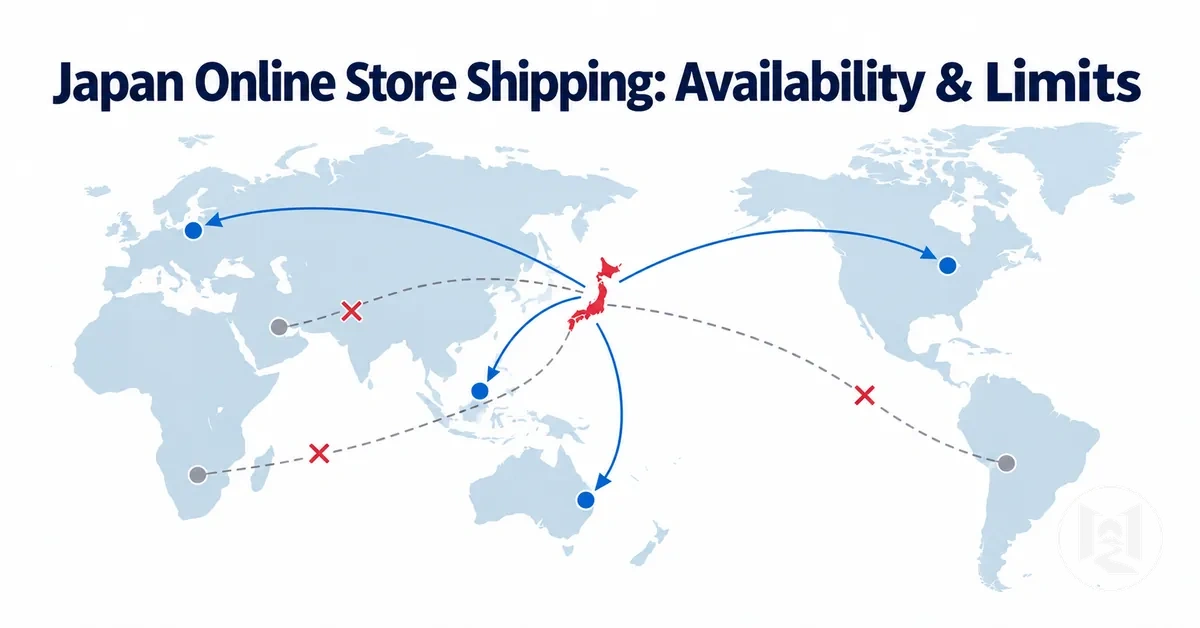
Check whether this order can ship internationally
Use the exact store, destination, item and shipping service for the order. Select the current state for each check; the result identifies any blocker. This verifies pre-shipment eligibility only; customs or duties after entry and later delivery conditions are separate.
Table of Contents
How to Check Whether a Japanese Store Offers International Shipping
To verify international shipping eligibility, check the store policy, exact destination, item eligibility, current shipping service, and any active exception or suspension for the proposed order.
Use published shipping terms, destination coverage, item restrictions and current service notices rather than relying on a general “worldwide shipping” claim; any failed criterion can block the order.

Eligibility checkpoints
- Shipping policy: Verify that the store permits direct international shipping; if its published policy limits delivery to domestic addresses, the proposed overseas order is not eligible for direct shipment.
- Destination support: Confirm that the destination falls within the store or shipping service's stated coverage; an unsupported destination cannot use that international-shipping option.
- Item eligibility: Check whether the specific item is permitted for international delivery; an excluded or restricted item can prevent shipment even when the destination is supported.
- Shipping service: Confirm that at least one eligible shipping service is available for the proposed item and destination; destination support without an applicable service does not make the order shippable.
- Suspension or exception: Check for a current suspension, temporary exception, or stated limitation that changes availability for an otherwise supported order context.
A store-level refusal is a broad direct-shipping limitation, while a destination, item, service or temporary-notice failure is specific to the checked order context.
If no shipping option appears, identify which check failed before assuming the cause.
Shipping Destinations and Geographic Limits
Shipping destination eligibility can exist at four geographic levels: country, region, service area and individual address. Support at a broader level does not guarantee support at a narrower one.
Check coverage from broad to specific because the applicable delivery boundary can narrow at each level.
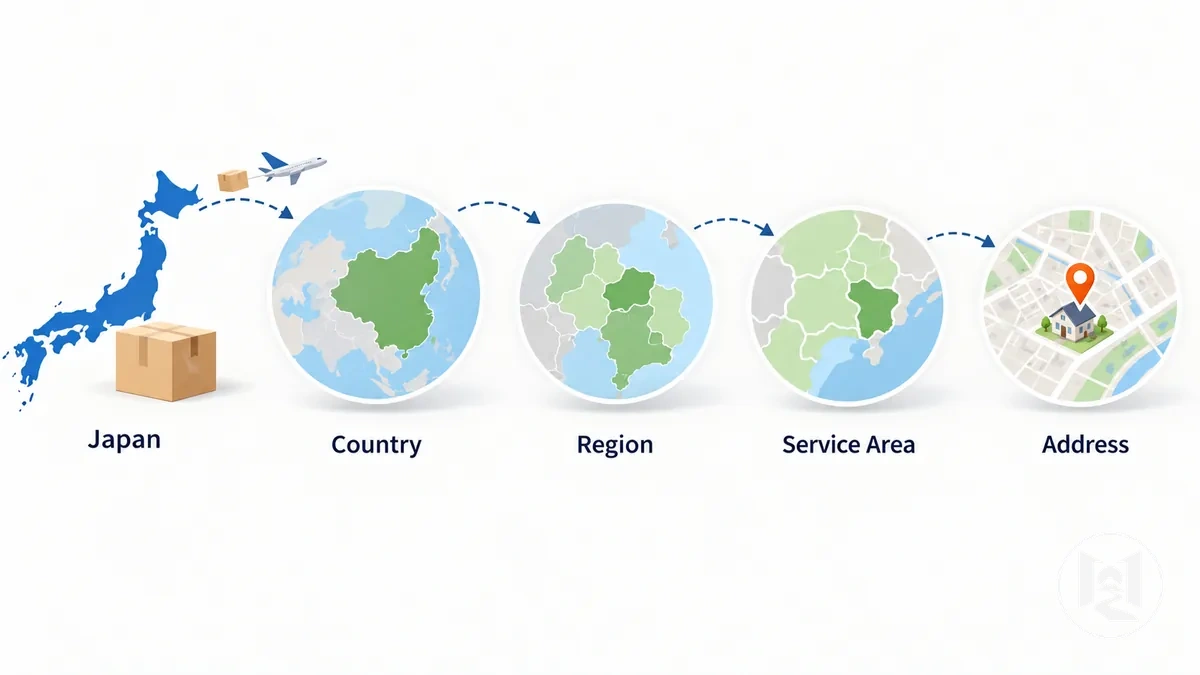
Coverage check: broadest to most specific
- Country: Country support establishes the broadest destination boundary; an unsupported country is outside the available international-shipping coverage.
- Region: Regional coverage can narrow eligibility within a supported country when only specified areas are served.
- Service area: A shipping service may operate only within defined delivery areas, so regional support does not by itself establish service-area eligibility.
- Address: The final address must fall within the applicable coverage for the available shipping service; a specific address outside that reach is not eligible through that service.
For example, a country can be listed as supported while a particular region, service area or address is not served under the current shipping conditions. This is a narrower coverage limit, not a contradiction of country-level support.
Temporary Service Suspensions and Destination Availability
The destination can remain within the store’s usual international-shipping scope.
A temporary suspension can make a particular service unavailable without permanently removing the destination from normal coverage.
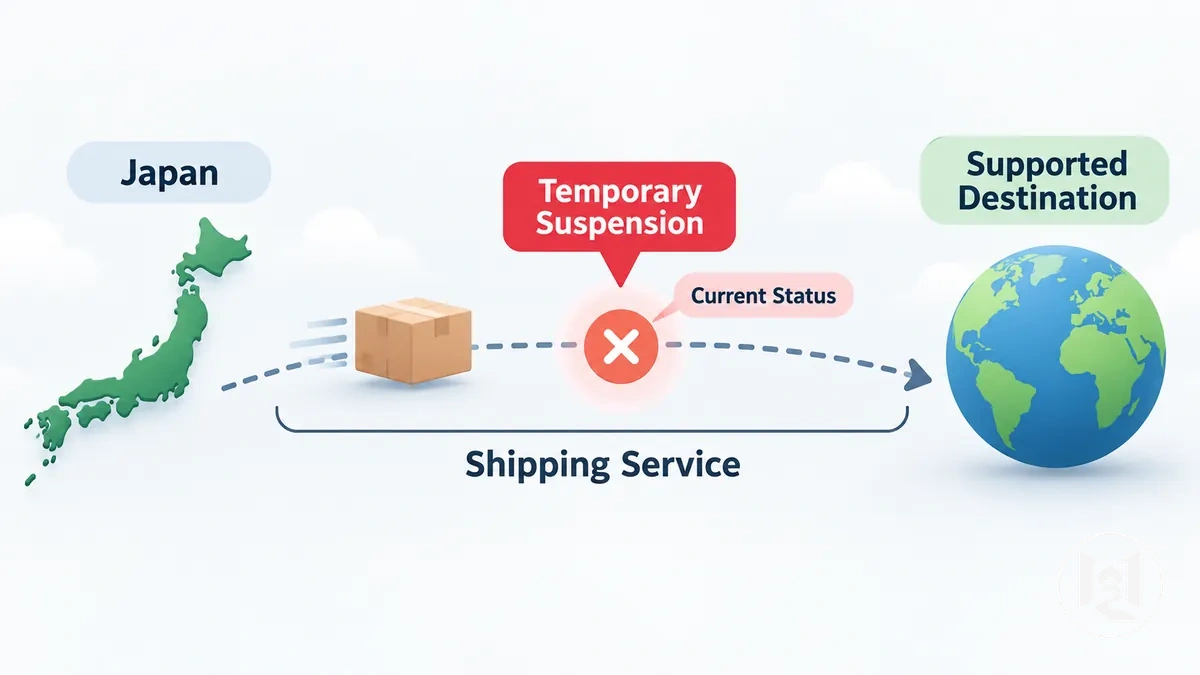
What can temporarily change service availability
- Carrier suspension: A carrier may temporarily stop accepting shipments for a destination, making that shipping service unavailable while the suspension remains in effect.
- Postal service suspension: A postal service may temporarily suspend acceptance or delivery for a destination, affecting current eligibility without necessarily changing normal destination coverage.
- Route disruption: A disruption affecting the applicable transport route can interrupt a shipping service for an otherwise supported destination.
- Destination-specific restriction: Temporary operational restrictions at the destination can limit service availability until the stated condition or effective period ends.
Because suspension notices are time-sensitive, verify the current carrier, postal service, or store notice and its stated effective period before treating the service as available.
An older notice should not be assumed to describe the present service state, and a current notice should be applied only to the destination and service scope it specifies.
A temporary suspension changes present eligibility for the affected service, not necessarily the destination’s permanent shipping status.
Item Eligibility and International Shipping Restrictions
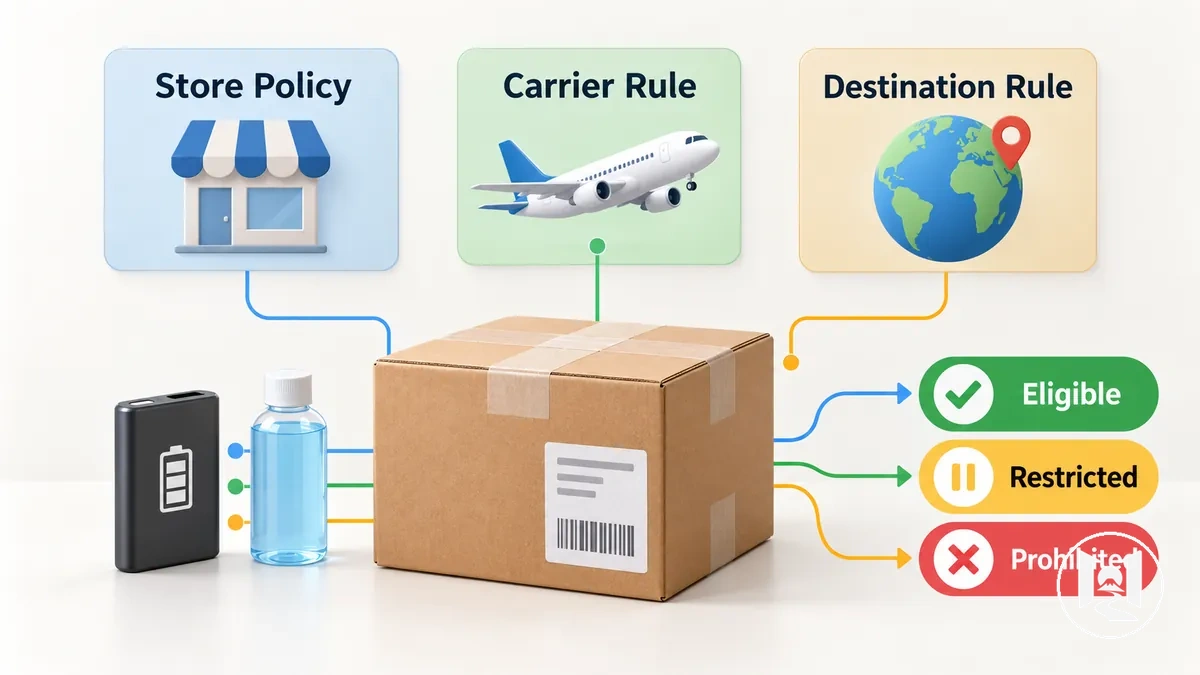
Item eligibility is separate from destination eligibility: a supported destination does not make every product shippable. The outcome depends on the item’s characteristics and the applicable store policy, carrier or service rule, Japanese export constraint, destination rule and shipment conditions.
Because each rule source evaluates a different part of the shipment, the same item can be accepted in one shipment context and rejected or restricted in another.
CDJapan publishes store-level restrictions under which some products are limited to shipping within Japan.
Japan Post states that lithium batteries sent by international mail must meet conditions concerning installation in equipment, battery capacity, quantity, and destination acceptance.
Japan Customs states that exports subject to other Japanese laws may require permits or approvals before Customs can permit export, while Australia's Department of Agriculture, Fisheries and Forestry states that certain food, plant material, and animal products sent to Australia must meet destination biosecurity conditions.
Rule sources to check for the specific item
- Store policy: Check whether the store permits international shipment of the item category; a store-level restriction can make the product ineligible even when another shipping service could technically carry it.
- Carrier or service rule: Check whether characteristics such as a battery, liquid, or other regulated content are permitted under the selected shipping service; a carrier rule may prohibit the item or accept it only under defined conditions.
- Export constraint: Check whether an applicable Japanese export rule requires permission, approval, or another condition; if a required condition is not satisfied, the item is not eligible for export under that rule.
- Destination restriction: Check the destination rule for the specific item category; a product accepted by the store and carrier can still be restricted or prohibited at the destination.
- Shipment-specific condition: Verify any applicable quantity, packaging, documentation, or service compatibility requirement; an item that meets those conditions may remain eligible even when unrestricted shipment is not permitted.
The governing rule blocks the item on this shipment path.
The item remains eligible only when the stated quantity, packaging, documentation, configuration, service or destination conditions are satisfied.
No applicable checked rule blocks the item for the proposed shipment context.
Customs and duties after entry are a separate question from pre-shipment item eligibility. Tax treatment does not by itself determine whether the item can be dispatched from Japan.
An item should be treated as prohibited only when the applicable rule excludes it, rather than when it merely requires a compatible service or defined shipping conditions.
Prohibited Items for International Shipping
A prohibited item is non-eligible when a governing store, carrier, export or destination rule does not permit it on the proposed shipping path. “Prohibited for this shipment path” does not mean universally prohibited everywhere.
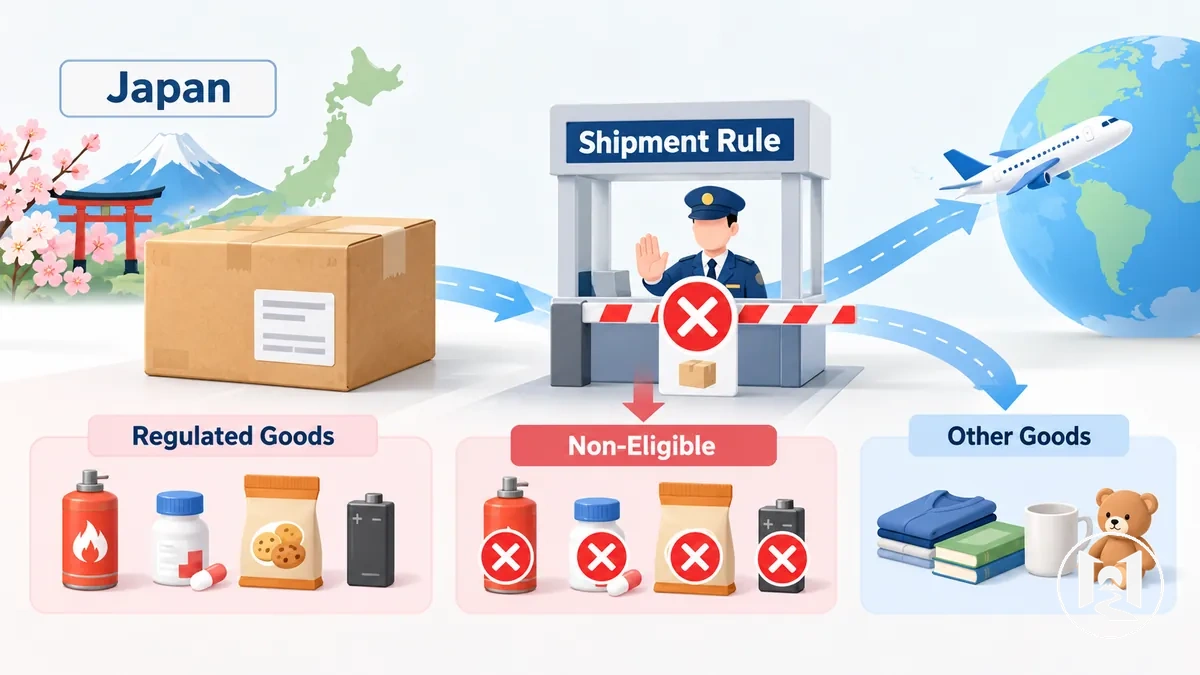
Where a prohibition can come from
- Carrier or postal prohibitions: Japan Post identifies dangerous goods that are not accepted in international mail, including fireworks, lighter fuel, compressed gases, matches, mercury, and radioactive substances. These item characteristics make the affected regulated goods non-eligible for that postal shipment under the applicable carrier rule.
- Japanese export prohibitions: Japan Customs states that the Customs Law prohibits export of specified categories including narcotics and psychotropic drugs, cannabis, opium, stimulants, child pornography, and certain intellectual-property-infringing goods. An item falling within an applicable prohibited export category is non-eligible for export from Japan under that export rule.
- Destination prohibitions: A destination rule may prohibit particular regulated goods even when a carrier could otherwise transport them. Food, medicine, alcohol, tobacco, weapons, or other regulated categories must therefore be assessed under the specific destination rule before they are classified as non-eligible.
- Store prohibitions: A store rule may refuse international shipment of a particular item category even when transportation and export rules would otherwise permit it. In that case, the item is non-eligible through that store rather than universally prohibited.
Tie each prohibition to its governing rule and shipment scope rather than inferring a universal ban from the product category alone.
Flammable goods provide a clear service-specific example because Japan Post lists multiple flammable substances among items that cannot be accepted in international mail, while other regulated goods may be governed by different store, export, carrier, or destination rules.
Items that are accepted only when defined conditions are satisfied are not absolute prohibitions and belong to the separate conditional-restriction category.
Restricted or Conditionally Shippable Items
A restricted item can remain eligible when the applicable conditions are satisfied. Conditional eligibility can depend on quantity, packaging, battery configuration, documentation, service type or a destination rule.
Conditions that can change item eligibility
- Quantity: An item may be eligible only within the quantity permitted by the applicable shipment rule; exceeding that permitted condition can make the shipment ineligible.
- Packaging: A restricted item may be accepted when the required packaging condition is satisfied and become ineligible when the applicable service does not accept the item in its presented packaging.
- Battery configuration: Eligibility can depend on how a battery is configured in relation to the equipment or shipment, so the same battery-related item class can receive different outcomes under different configuration rules.
- Documentation: Where the governing rule requires specified documentation, the item may be accepted only when that requirement is satisfied; missing required documentation can make the shipment ineligible.
- Service type: A restricted category may be eligible through one compatible shipping service but unavailable through another service whose acceptance rules do not permit that item or condition.
- Destination rule: A destination may impose a condition that changes whether a restricted item is eligible, even when the store or carrier would otherwise accept the shipment.
The same restricted item can receive different eligibility outcomes when a relevant condition changes.
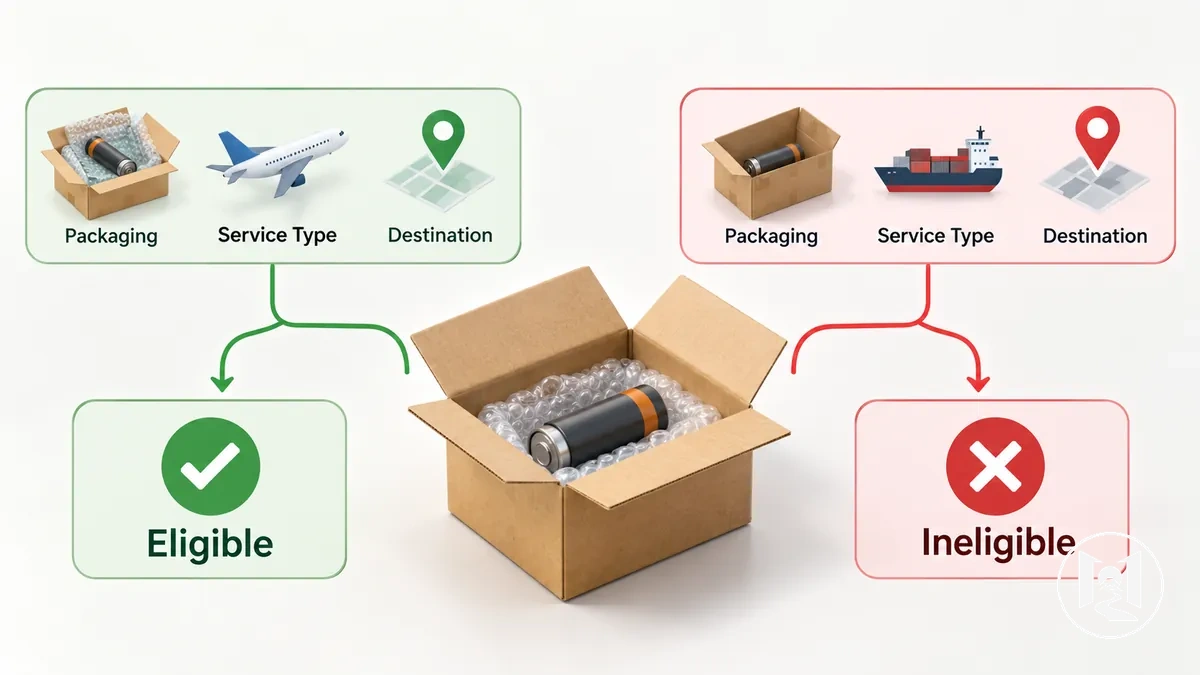
For example, an item class may be eligible when its required packaging and service conditions are satisfied but ineligible when a different service does not accept that configuration.
Meeting one condition does not guarantee acceptance across every service or destination. Eligibility changes with the applicable condition, service type and destination rule rather than the item name alone.
Carrier and Shipping-Service Limits That Affect Eligibility
The shipping service is the final pre-shipment gate: store approval, destination coverage and item eligibility are not enough unless a current service also accepts the proposed shipment.
Service-level eligibility depends on current availability, destination coverage, size, weight and item-handling rules. These limits are service-specific, so exact dimensional and weight limits must be checked for the selected service rather than assumed to apply across carriers.
Service-level checks
- Service availability: The shipping service must currently be available for the proposed shipment; if it is suspended or unavailable for that shipment context, it cannot provide an eligible route.
- Destination coverage: The carrier service must serve the proposed destination under its current coverage; a destination outside that service area makes the shipment ineligible for that service.
- Size limit: The parcel must remain within the applicable dimensional limits of the selected service; exceeding its size limit makes that parcel ineligible for the service.
- Weight limit: The shipment must remain within the applicable weight limit; a parcel above that limit is not eligible for that service and would require another applicable option.
- Item-handling rule: The item's characteristics and shipment configuration must satisfy the selected service's handling restrictions; failure to meet an applicable rule makes the shipment ineligible for that service even when the item is otherwise permitted.
Once the store, destination, item, and available carrier service all satisfy their respective conditions, the order can proceed through the direct international-shipping method supported by that service.
Understanding how direct international shipping works is a separate method question; for eligibility, the relevant point is that the proposed shipment has been accepted under the selected service's current conditions.
Pre-shipment service acceptance is different from what happens after dispatch, when tracking, delays, failed delivery attempts, or other delivery problems may arise.
Guidance used to troubleshoot delivery problems from Japan therefore addresses a later stage rather than the eligibility decision itself.