
Customs Duties, Tariffs and Import Taxes on Orders from Japan
Customs charges on orders from Japan are determined by the destination country’s import rules, not by one universal Japanese rate. What you may owe depends mainly on the goods’ tariff classification, customs value, country of origin, applicable thresholds or exemptions, and the destination’s duty and import-tax rules; carrier clearance or handling fees can be separate.
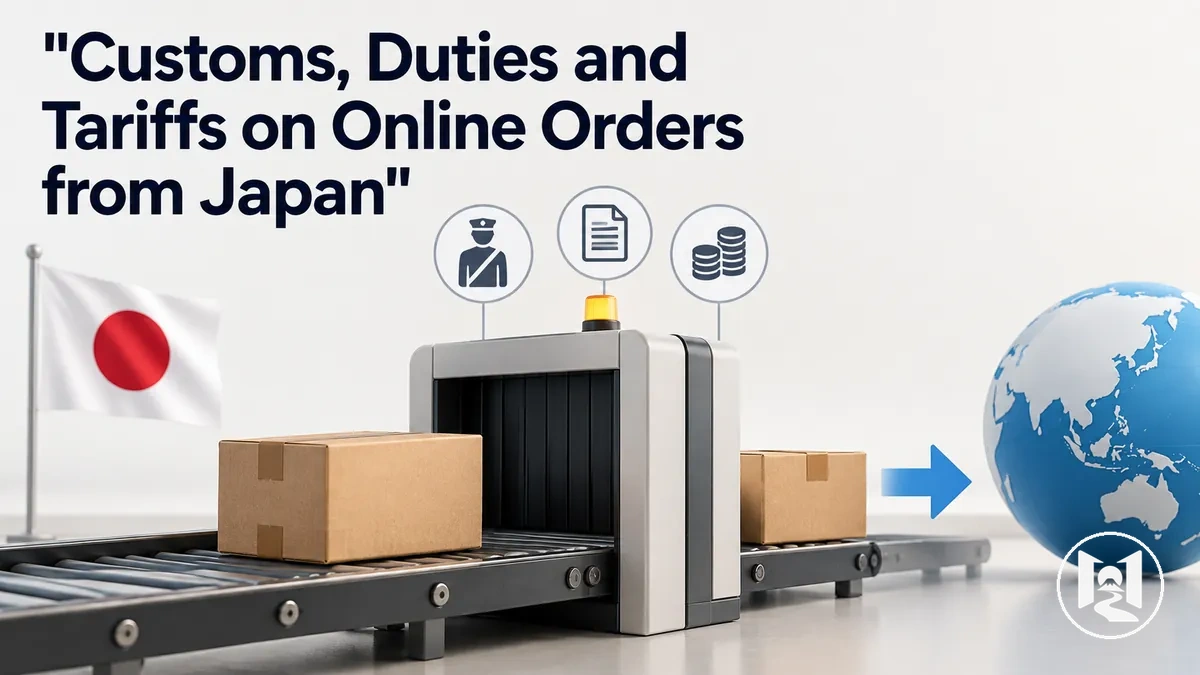
At a glance: what determines customs charges
Being shipped from Japan is only the starting fact. Customs assessment follows a chain of shipment facts and destination-country rules.
- Destination rules
- Set the applicable thresholds, exemptions, valuation rules, tax base, rates and clearance procedure.
- Tariff classification
- Connects the goods to the relevant tariff category and duty treatment.
- Country of origin
- Can affect tariff treatment and is not necessarily the same as the country from which the parcel was shipped.
- Customs value
- Provides the valuation base, usually starting from the transaction value with any adjustments required under the destination’s rules.
- Thresholds and exemptions
- Change the assessment only when the shipment meets the rule’s specific value, goods, purpose or other qualifying conditions.
- Payment arrangement
- Determines whether the seller collects charges in advance, the recipient pays later, or a carrier advances an amount and then collects it.
- 1Identify the goods and origin. Customs needs enough product information to classify the goods and apply any origin-related treatment.
- 2Establish the customs value. The accepted valuation base is determined from the transaction and the adjustments required by local rules.
- 3Apply thresholds, exemptions and rates. Duty and import tax are calculated against the bases defined by the destination country.
- 4Complete clearance. The parcel may be released, require payment or information, or remain under review if another condition is unresolved.
Key limit: there is no single worldwide duty rate, tax-free threshold or exemption that applies to every online order shipped from Japan.
The World Customs Organization treats classification, valuation and origin as core customs concepts for imported goods. These customs obligations remain distinct from the seller’s product price and ordinary shipping charges, even when several amounts are collected during the same delivery process.
Table of Contents
Customs Charge Types and When They Apply to Orders from Japan
Customs charge applicability depends on both the charge type and the destination country's rules for the particular shipment.
Customs duty, tariff treatment and import tax can apply differently according to the goods, customs value, country of origin, thresholds and exemptions.
Several customs-related charges can affect the same order, but they arise under different conditions.
Customs duty is linked to the destination country's tariff treatment of the goods, while import tax is assessed under the destination country's tax rules when the shipment falls within the relevant taxable conditions.

- Customs duty: may be assessed when the destination country's tariff rules treat the goods as dutiable, with classification and country of origin affecting the applicable treatment.
- Import tax: may apply when the destination country's tax rules cover the imported goods and no applicable threshold or exemption removes that liability.
- Goods category and classification: determine which tariff treatment or import rules apply to the product, which can change whether customs duty is assessed.
- Customs value: can affect value-based assessment or threshold tests where the destination country's rules use customs value for those purposes.
- Thresholds and exemptions: can change whether a duty or import tax is due when the shipment meets the destination country's specific value, goods or eligibility conditions.
These applicability conditions operate together rather than as a single universal test.
The goods category can determine the relevant tariff treatment, customs value can affect a value-based threshold, and an exemption can change the assessment only when its qualifying conditions are satisfied.
The result therefore depends on the destination country's import rules and the characteristics of the specific shipment.
Customs-imposed charges are separate from the seller's product price and ordinary carrier shipping charges, even when several amounts are collected during the same delivery process.
A seller fee or carrier fee does not become a customs duty or import tax simply because it appears on an international order.
Duties, Tariffs and Import Taxes
Duties, tariffs and import taxes are related customs concepts, but they are not universally interchangeable.
The World Trade Organization uses tariff for customs duties on merchandise imports, while destination-country law determines how particular duties and other import taxes are defined and collected.
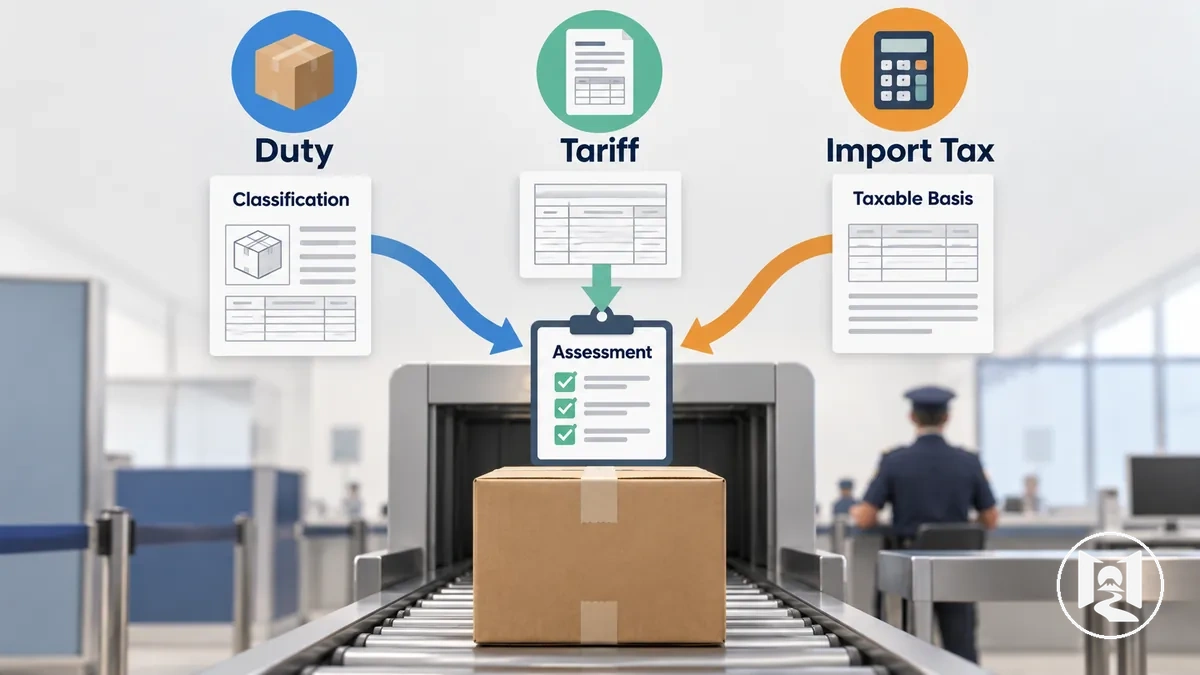
A duty is a customs charge assessed under the applicable tariff treatment, while a tariff can refer to that customs duty or to the rate schedule governing it.
An import tax is a separate tax on imported goods where the destination country's rules establish that liability.
Depending on the applicable system, a duty may use customs value or a specified quantity as its basis, while an import tax follows the taxable basis defined by the relevant tax rules.
| Term | What it refers to | Typical basis or trigger | Practical implication |
|---|---|---|---|
| Duty | A customs charge assessed on imported goods under the destination country's tariff rules. | Goods classification, country of origin and the applicable tariff treatment; the assessment basis may be customs value or a specified quantity. | The parcel may have customs duty payable as part of import clearance. |
| Tariff | A customs duty on merchandise imports, or the rate schedule governing that duty, depending on context. | The destination country's tariff schedule, product classification and applicable origin treatment. | The tariff treatment determines which customs-duty rule or rate applies to the imported goods. |
| Import tax | A tax imposed on imported goods under the destination country's tax rules, distinct from customs duty where the jurisdiction treats them separately. | The applicable tax law and its defined taxable basis or triggering conditions. | An import tax may create a separate liability in addition to customs duty when the shipment meets the relevant taxable conditions. |
The terminology must therefore be interpreted under the destination country's rules rather than treated as three fixed worldwide definitions.
For an imported parcel, the key distinction is which charge is being assessed, what basis or rate governs it, and whether it creates a separate liability at clearance.
Destination-Country Thresholds and Exemptions
Destination-country thresholds and exemptions are separate legal conditions that can change whether customs duty, import tax, or simplified customs treatment applies to an order from Japan.
A threshold tests a shipment against a defined condition such as shipment value, while an exemption applies only when the goods or shipment satisfy the qualifying conditions set by the destination country.
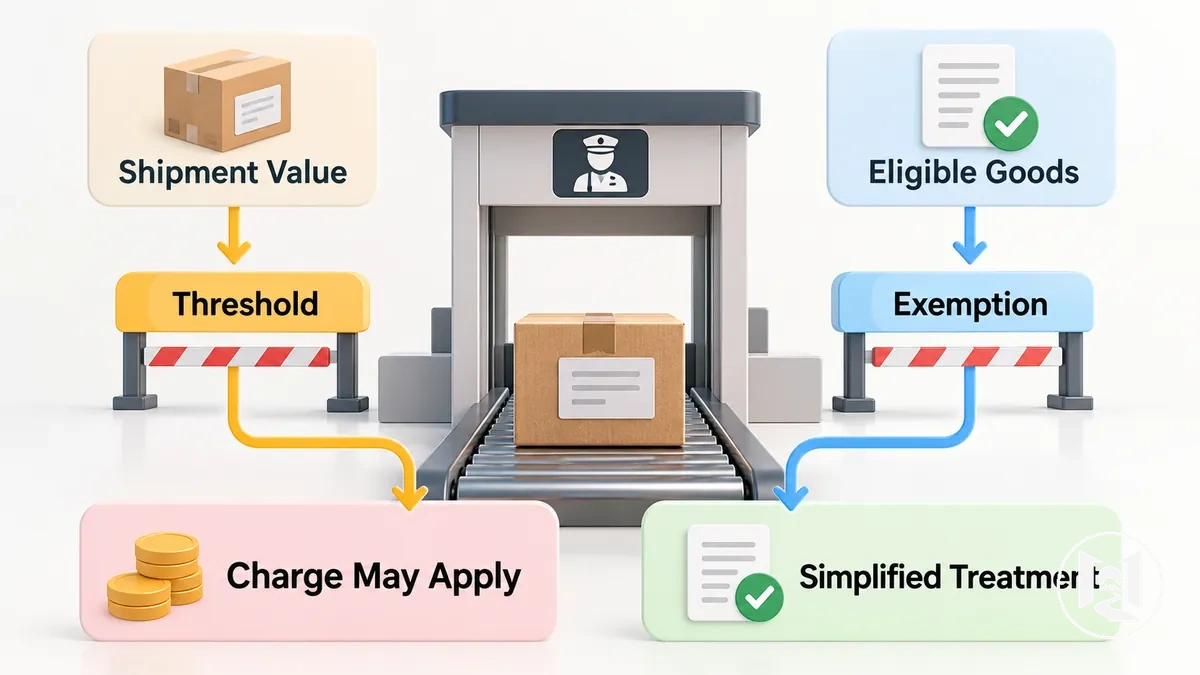
Threshold condition: A threshold test compares the shipment with a limit or eligibility condition defined by the destination country's import rules.
The result can change whether a charge applies or whether simplified treatment is available.
- Shipment value: the relevant customs or shipment value is compared with the applicable value threshold where the destination country's rules use one.
- Goods eligibility: a threshold may apply only to goods that fall within the categories covered by that rule.
- Threshold outcome: falling within or outside the applicable condition can change whether customs duty, import tax, or simplified clearance treatment applies.
Exemption condition: An exemption is a separate eligibility test rather than another name for a threshold.
It changes the assessment only when the shipment satisfies the qualifying conditions specified by the destination country.
- Eligible goods: the goods must fall within any categories covered by the exemption.
- Shipment purpose: where the destination country's rules distinguish purposes such as personal purchases or qualifying gifts, that purpose can affect exemption eligibility.
- Qualifying conditions: any required value, goods, recipient, or shipment conditions must be satisfied for the exemption to affect the customs assessment.
How Customs Value Is Determined for a Parcel from Japan
Customs value is the valuation base customs authorities use to assess an imported parcel, and it is not automatically the same as the purchase price or the total amount eventually paid to receive the order.
The World Customs Organization explains that the primary basis under the WTO Customs Valuation Agreement is transaction value: the price actually paid or payable for goods sold for export to the destination country, with specified adjustments where applicable.
The purchase price normally provides the starting transaction information, while a genuine discount can affect that starting amount when it changes the price actually paid or payable and is accepted under the destination rules.
Shipping and insurance may be included, excluded, or partly included in customs value according to the destination country's valuation rules; the WTO Customs Valuation Agreement permits members to determine the treatment of these transport- and insurance-related amounts.

The declared value should be supported by transaction evidence such as an invoice, payment record and other supporting documents that establish the amount paid and any relevant adjustments.
A declared value is not automatically the final customs value if the customs authority questions the information or the applicable valuation method requires an adjustment.
When currency conversion is necessary, the WTO Customs Valuation Agreement provides that the conversion uses an exchange rate published by the competent authority of the importing country, with the applicable timing determined under that country's rules.
Customs value remains distinct from the final tax bill and total landed cost: it establishes an assessment base, while duties, import taxes, clearance charges and other downstream costs are determined separately under the applicable rules.
The amounts included in customs value therefore depend on the destination rules, the valuation method and the supporting evidence for the particular transaction.
Which Costs Can Be Included in Customs Value
Some cost components may form part of customs value when the governing valuation method requires them to be included in the assessment base.
The transaction price is generally the starting amount, while the treatment of transport, insurance, packing, commissions and other additions depends on the destination country's valuation rules and the shipment terms.
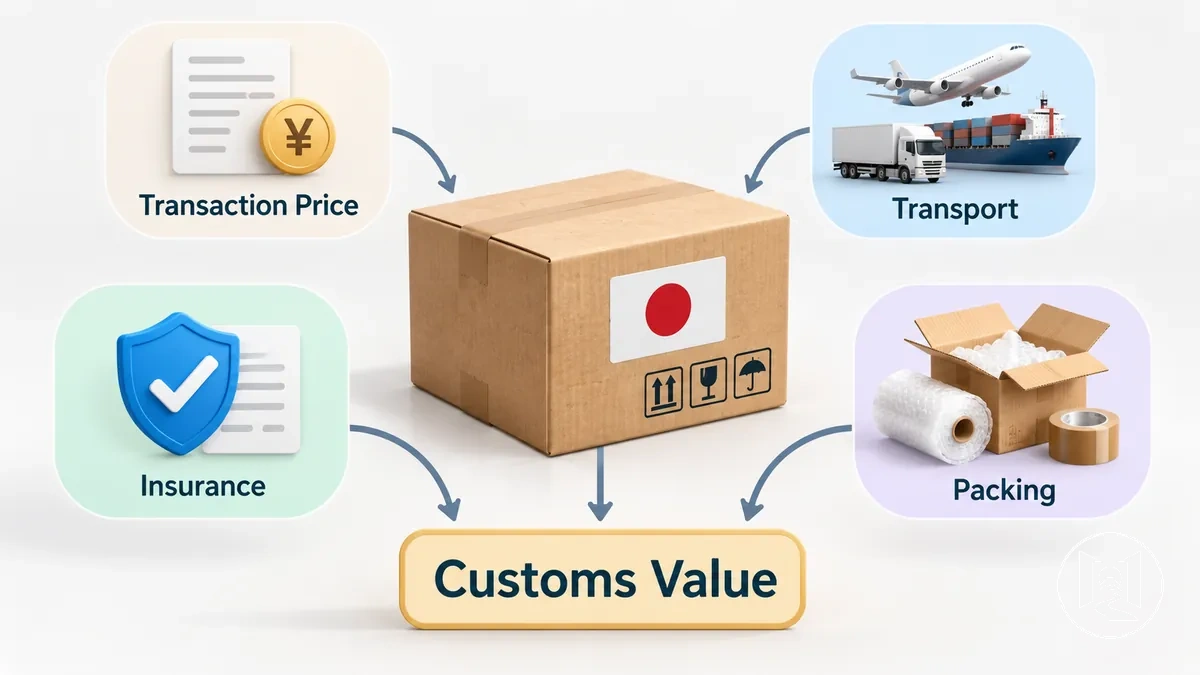
- Transaction price: the purchase price can form the starting valuation amount when the applicable method accepts the transaction and the price reflects the amount paid or payable for the imported goods.
- Transport or freight: transport costs may be included when the destination country's valuation rules require costs to the relevant customs valuation point to form part of customs value and those costs are not already reflected in the transaction price.
- Insurance: insurance can increase the valuation base when the applicable rules treat insurance for the imported shipment as an includable amount and it has not already been incorporated into the transaction price.
- Packing: packing or packaging costs may be added when the governing valuation method treats those costs as part of the value of the imported goods and they are not already included in the transaction price.
- Assists: goods or services supplied for use in producing the imported goods can affect customs value when the applicable valuation rules classify them as an addition and their value is not already included in the transaction price.
- Commission and other relevant additions: a commission or another transaction-related amount affects customs value only when the destination country's rules classify that particular amount as an addition under the applicable valuation method.
Two parcels with the same purchase price can therefore have different customs values if their destination rules or shipment terms require different ancillary costs to be added.
The inclusion condition for each component determines whether it changes the valuation base rather than the component name alone.
How Declared Value and Supporting Documents Affect Valuation
The declared value and supporting documents help customs verify the transaction and valuation facts for a parcel from Japan, but the declared value does not automatically determine the final customs value.
The distinction is between the value presented in the declaration and the verified customs value accepted or established after the available transaction records are reviewed.
An invoice, payment record, order confirmation and shipping document can support different parts of that verification.
Consistent records help connect the purchase price, goods description, quantity and shipment details to the declared value.
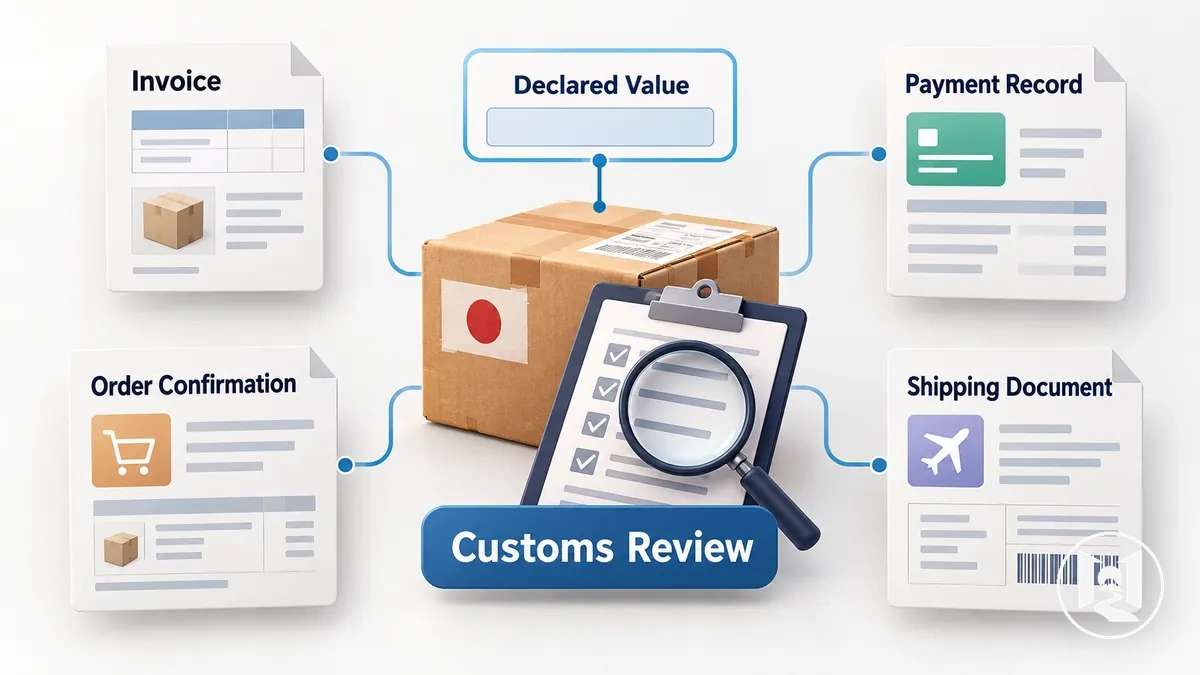
| Document or record | What it helps verify | Possible issue if inconsistent |
|---|---|---|
| Invoice | Transaction value, purchase price, goods description and quantity shown for the sale. | A mismatch with the declaration or other transaction records may prompt clarification or additional valuation evidence. |
| Payment record | The amount actually paid or payable and its connection to the transaction. | A payment amount that conflicts with the invoice or declared value may require further explanation. |
| Order confirmation | Ordered goods, quantities, purchase price and transaction details recorded at the time of purchase. | Differences from the invoice or declaration can create an inconsistency that customs may seek to clarify. |
| Shipping document | Shipment details such as the goods description, quantity and other transport-related information relevant to verification. | Conflicting shipment information may lead customs to request additional information before accepting or reassessing the customs value. |
An inconsistency or missing supporting record does not by itself establish the correct customs value or imply misconduct.
It may prompt a request for clarification or additional information, and customs can use a different valuation approach when the declared transaction information cannot be verified under the applicable rules.
How Import Duty and Tax Are Calculated from Customs Value
Import duty and tax are calculated through a dependency chain: the customs value provides the valuation input, the tariff classification identifies the applicable duty treatment, and destination-country rules determine the duty rate, tax base and import tax rate used for the assessment.
Because those inputs and the calculation order can differ by jurisdiction, the duty calculation and tax calculation should be treated as related but separate stages.
Before calculating an assessed amount, identify the accepted customs value, the tariff classification and the duty rate that applies under the destination rules.
Then establish how that jurisdiction defines the taxable value for import tax, including whether customs duty or other permitted amounts are added to the tax base.
Any applicable exemption, surcharge or special calculation rule should also be identified before the final assessment is verified.
- Identify the customs value: use the customs valuation amount accepted for the shipment as the starting input for the assessment.
- Determine the tariff classification and duty rate: use the goods classification and applicable tariff treatment to identify the rate or other duty rule that applies to the shipment.
- Calculate the duty amount: apply the applicable duty rate or calculation rule to the duty base required by the destination country, producing the customs-duty amount.
- Establish the tax base: determine the taxable value under local rules. Depending on the jurisdiction, the tax base can include the customs value, assessed duty and other amounts specified by those rules.
- Apply the import tax rate and verify the assessment: apply the applicable import tax rate to the established tax base, then verify whether exemptions, surcharges or jurisdiction-specific calculation-order rules change either assessed amount.
Calculation: $100 × 5% = $5 duty; if local rules define the tax base as customs value plus duty, $105 × 10% = $10.50 import tax.
The figures show the calculation mechanics only. Actual duty formulas, tax bases, rates and calculation order depend on the destination jurisdiction.
How Tariff Classification Determines the Duty Rate
Tariff classification maps imported goods to a customs category linked to the applicable tariff treatment and duty rate in the destination country's tariff schedule.
The classification code therefore determines which rate schedule or tariff provision is applied, while the final duty treatment can also depend on other rules relevant to the classified goods.
Tariff classification is evaluated using the characteristics and legal description of the goods rather than a retailer label or marketplace category alone.
Relevant characteristics can include the goods description, material, composition, function and construction, with each attribute affecting classification only where the applicable tariff rules distinguish goods on that basis.
- Goods description: the description identifies what the goods are and helps match them to the relevant customs category rather than relying on a broad commercial label.
- Material: the material can affect tariff classification when the tariff schedule distinguishes products according to what they are made from.
- Composition: the combination or proportion of materials can affect the classification code when tariff categories distinguish goods by their physical composition.
- Function: what the product does or how it is used can affect classification when the applicable tariff provisions distinguish goods by function or use.
- Construction or components: relevant parts and construction characteristics can affect which customs category applies when otherwise similar goods fall under different tariff provisions.
A material, component or functional difference can therefore result in a different tariff classification and consequently a different duty treatment or duty rate.
The applicable classification must be determined under the destination country's tariff rules rather than assumed from the seller's product name or marketplace category.
Country of Origin Versus Country of Shipment for Tariff Purposes
Country of origin and country of shipment describe different facts about imported goods.
Country of shipment identifies where the parcel was dispatched from, while country of origin is determined under the applicable origin rules and can affect the tariff treatment applied to the goods.
The distinction matters because logistics evidence and origin evidence answer different questions.
Shipping documents can support the dispatch country and transport route, while origin-related evidence may include manufacturing information, origin statements or other records relevant under the applicable rules.
A parcel leaving Japan therefore does not by itself establish Japanese origin or entitlement to any particular tariff preference.
| Concept | What it describes | Evidence to check | Possible tariff implication |
|---|---|---|---|
| Country of origin | The country attributed to the goods under the applicable origin rules, based on the criteria those rules use for production or processing. | Manufacturing information, origin statements, certificates where applicable, and other records supporting the origin determination. | May affect the applicable tariff treatment, including eligibility for preferential treatment when the relevant origin conditions are satisfied. |
| Country of shipment | The country from which the parcel or goods were dispatched as part of the logistics movement. | Shipping document, transport record, dispatch information or tracking evidence identifying where the shipment began. | Shows the shipping origin but does not by itself determine the legal country of origin or the duty rate. |
For example, goods manufactured in another country can be stored by a Japanese seller and later dispatched from Japan.
Japan would be the country of shipment in that scenario, while the country of origin would still be determined from the applicable origin rules and supporting evidence, which may lead to different tariff treatment from goods that legally originate in Japan.
How Duty and Import Tax Rates Are Applied to the Taxable Value
Once the relevant bases have been established, the applicable duty rate is applied to the duty base and the import tax rate is applied to the jurisdiction-defined tax base to produce each assessed amount.
The basic arithmetic is applicable rate × applicable base = calculated charge, but the customs value, taxable value, rate source and calculation order must be identified under the destination country’s rules before that arithmetic is meaningful.
The duty base may be the customs value or another value defined by the applicable customs rules, while the import-tax base can be different.
Depending on local rules, the taxable value for import tax may include the customs value, assessed duty or other amounts permitted by those rules.
The selected rate must therefore be matched to the correct base rather than applying both rates to one assumed amount.
| Charge | Applicable base | Rate source | Calculated result |
|---|---|---|---|
| Duty | Illustrative duty base: $200 | Illustrative hypothetical tariff schedule: 5% | Illustrative assessed duty: $10 |
| Import tax | Illustrative tax base: $210, assuming local rules define it as $200 customs value plus $10 duty | Illustrative hypothetical import-tax rules: 10% | Illustrative assessed import tax: $21 |
This example illustrates only how a rate operates on its applicable base; the percentages and amounts are not current rates for any destination.
Local rules can define a different duty base or tax base and can also affect rounding, minimum charges, surcharges, additional levies or the sequence in which amounts enter the assessment.
Who Pays Customs Charges on an Order from Japan
Responsibility for customs charges depends on the shipment terms, the seller or carrier arrangement, and the destination country's collection process.
The party responsible for the charge and the party that collects or advances the payment can be different, so payment responsibility and collection timing should be considered separately.
What Happens During Customs Clearance for a Parcel from Japan
Customs clearance normally moves a parcel through presentation of shipment data, document review, customs assessment, any required controls, and then release or a hold for further action.
The exact procedure varies by destination country, and physical inspection is a possible customs action rather than a step applied to every parcel.
The customs stage begins after the parcel enters the destination country's import stream and the relevant customs declaration and supporting shipment information are presented for review.
Each stage determines whether the shipment can proceed, requires an assessment or additional information, or must remain under customs control.
- Shipment data and customs declaration are presented: information about the parcel, goods and transaction is submitted or made available for customs processing. If the required data is sufficient, the shipment proceeds to document review; missing or unclear information can lead to a request for further details.
- Documents are reviewed: the customs declaration and supporting records are checked for information relevant to the import assessment. Consistent information allows processing to continue, while an inconsistency can result in additional review.
- Valuation, classification and charges may be assessed: customs may verify the customs value and tariff classification and determine whether duty and tax or other applicable import charges are due. The shipment can then proceed with an assessed amount, proceed without those charges where the applicable rules allow, or remain under review if the available information is insufficient.
- Customs controls may be applied: where required by the destination country's rules or risk controls, the parcel may undergo additional documentary checks or physical inspection. A shipment that satisfies the applicable requirements can continue toward release, while unresolved issues can place it on hold.
- The parcel is released or held: after the required assessment, payment and controls are completed, the parcel can be released from customs processing. If information, payment or another customs requirement remains unresolved, the shipment can stay on hold pending further action.
Routine customs clearance ends with release from the customs stage, while a hold indicates that further customs action or information is required.
Customs clearance is only one stage of the broader international shipping process rather than the complete delivery journey.
Declaration and Document Review
Declaration and document review checks whether the customs declaration and supporting shipment documents provide sufficiently consistent information for the destination country's customs assessment to proceed.
Customs commonly reviews the declared goods, shipment parties and transaction information, although the exact document requirements vary by destination country and shipment type.
The review compares declaration data with supporting records to verify the facts relevant to import processing.
The information categories below do not represent a universal document list or a mandatory review order.
- Goods description: the description is checked to identify what the goods are and whether the declaration and supporting records describe them consistently; unclear or conflicting descriptions may require clarification.
- Quantity: the declared number, weight or other applicable quantity is compared with shipment or commercial records so the amount of goods being imported can be verified.
- Value: the declared value is compared with relevant commercial information, such as an invoice or payment-related record where required, to support the value used for customs processing.
- Origin: origin information is reviewed against available evidence where origin affects the applicable customs treatment; inconsistent information may require additional supporting evidence.
- Classification: classification information is checked against the goods description and other relevant product characteristics to determine whether the stated customs classification is sufficiently supported for assessment.
- Consignee details: recipient or consignee information is checked against the shipment data so the party associated with the import can be identified correctly for the applicable process.
- Supporting records: commercial and transport records may be compared with the customs declaration to verify transaction and shipment facts and identify material inconsistencies.
Incomplete or inconsistent information does not necessarily cause a hold by itself.
Depending on the destination country's requirements and the significance of the discrepancy, customs or the party handling clearance may request clarification, additional supporting records, a correction or further review before the assessment proceeds.
Assessment, Inspection and Release
After customs assessment, a parcel may move directly toward release, require payment of duty and tax, undergo inspection, or enter additional review depending on the assessment outcome and applicable requirements.
Inspection is conditional rather than automatic, and release occurs only when the relevant customs, compliance and payment conditions have been satisfied.
The assessment establishes the shipment's customs state using factors such as valuation, classification and any resulting charges.
If the information supports routine processing, the parcel may proceed without physical inspection; where customs requires further verification, an inspection or other compliance check may occur.
Payment status is one release condition when duty and tax are payable, but payment alone does not resolve an outstanding compliance issue or additional review.
- Assessment is completed: customs determines the relevant valuation, classification and assessed charges, producing either a routine processing state or a need for further action.
- Additional checks may be required: the parcel may undergo inspection or further evidence review when customs needs to verify the goods or their compliance status; inspection does not by itself indicate a violation.
- Payment and compliance status are checked: where duty and tax are due, the required payment must reach the necessary status, while any separate customs or compliance requirement must also be resolved.
- A release decision is made: the parcel is released when the applicable assessment, payment and compliance conditions are satisfied; otherwise, it can remain under additional review until the unresolved requirement is addressed.
A parcel that clears through routine assessment can therefore reach release without an inspection, while another shipment may require extra checks before its compliance status is resolved.
The possible next states are release or continued customs review, depending on which applicable requirements remain outstanding.
Why Customs May Hold a Shipment from Japan
A customs hold may occur when missing information, a valuation check, a classification check, unpaid charges, admissibility requirements, or a compliance check requires additional review before release.
A customs hold is a shipment state, not proof of one specific cause, so a tracking message alone does not confirm why customs processing has paused.
The main cause classes involve information that customs cannot yet verify, an assessment that needs further examination, a payment condition that remains unresolved, or a regulatory requirement that needs confirmation.
Tokyo Customs states that an inquiry may be made to the recipient when the value of a parcel's contents is unknown or when other relevant laws and regulations require confirmation.
DHL also identifies documentation, declared value, classification, duties and taxes, inspection, and regulatory requirements as factors that can affect customs clearance.
| Possible trigger | What customs may check | Likely next requirement |
|---|---|---|
| Missing information or inconsistent documents | Customs may compare the goods description, declared information and supporting documents to determine which facts remain unclear. | Clarification, corrected information or additional supporting documents may be requested before processing continues. |
| Valuation check | Customs may review the declared value and available transaction evidence when the value needs verification for assessment. | Evidence supporting the transaction or declared value may be requested, followed by confirmation or reassessment. |
| Classification check | Customs may compare the goods description and product characteristics with the declared tariff code or classification information. | More detailed product information or supporting classification evidence may be needed before the applicable tariff treatment is confirmed. |
| Unpaid charges | Customs processing may check whether assessed duty and tax or other required customs amounts have reached the necessary payment status. | Payment of the assessed amount may be required before release where the destination country's rules make payment a clearance condition. |
| Admissibility or compliance check | Customs may review whether the goods satisfy applicable import restrictions, permit requirements or other regulatory conditions. | Additional evidence, a permit, confirmation from the recipient or another compliance action may be required before a release decision can be made. |
Each trigger can produce a different type of additional review, so the next action depends on the unresolved condition rather than on the hold label itself.
A document discrepancy can lead to a clarification request, a valuation issue can lead to supporting-evidence review, and an unresolved payment or compliance condition can prevent release until the applicable requirement is satisfied.
Not every delay occurring near the customs stage is an actual customs hold.
Tokyo Customs notes that a tracking status such as “Held by import Customs” can also reflect postal processing or sorting while a parcel is undergoing customs clearance, so the observable tracking status requires confirmation before a specific customs cause is assigned.
Missing, Incomplete or Inconsistent Shipment Information
Missing, incomplete or inconsistent shipment information can interrupt customs processing when customs cannot verify facts needed for assessment or release.
The consequence depends on the materiality of the information defect and the destination country's procedure; an inconsistency may trigger clarification, correction or a request for additional supporting evidence rather than automatically producing a lengthy hold.
Common problems involve conflicts between the customs declaration and the commercial or shipment records used to support it.
The categories below show the information defect, the fact that becomes difficult to verify, and the possible clarification consequence without implying an order of severity.
- Goods description: a vague, incomplete or conflicting goods description can prevent customs from confirming what is being imported and whether the declaration corresponds with the supporting records; a clearer product description or additional product information may be requested.
- Declared value: when the declared value conflicts with the invoice or other transaction evidence, customs may be unable to verify the value used for assessment; clarification, corrected data or evidence supporting the transaction amount may be required.
- Quantity: a difference between the declared quantity and the quantity shown on shipment or commercial documents can create uncertainty about how many goods are being imported; customs may request confirmation or correction of the relevant record.
- Origin: missing or conflicting origin information can prevent verification of the origin used for customs treatment where origin is relevant; supporting origin information or a correction may be requested before processing continues.
- Consignee data and supporting documents: incomplete consignee data or inconsistencies between shipment documents can make it difficult to verify the recipient or connect the records to the same shipment; customs or the party handling clearance may request corrected details or additional supporting records.
For example, if an invoice shows one transaction value while the customs declaration shows a different declared value, the inconsistency does not by itself establish misconduct.
It can require clarification or supporting evidence so customs can determine which value is supported before the assessment proceeds.
Valuation and Classification Checks
Customs may pause clearance when the declared value or tariff classification needs verification before the shipment's assessment can be completed.
A valuation review tests whether the declared amount can support the customs value, while a classification review tests whether the goods description and product characteristics support the declared tariff treatment; an unusual value or classification uncertainty may prompt review but does not by itself prove misdeclaration.
The two checks examine different attributes and can therefore be raised independently or together.
Customs may compare the declaration with supporting documents and other information relevant to the specific question before confirming the existing assessment or making a reassessment.
| Check type | Typical trigger | Information reviewed | Possible outcome |
|---|---|---|---|
| Valuation | A declared value that is unclear, inconsistent with transaction records, or otherwise requires verification for the customs assessment. | The declared value, invoice or other transaction evidence, and supporting documents relevant to establishing the customs value. | The declared basis may be accepted, additional supporting information may be requested, or the customs value can be reassessed under the applicable rules. |
| Classification | An unclear goods description, conflicting product information, or classification uncertainty about which tariff provision applies. | The goods description, material, composition, function or other relevant product characteristics used to support the tariff classification. | The declared classification may be accepted, more product information may be required, or the classification and resulting duty treatment can be reassessed. |
For example, customs could question the declared value because it conflicts with an invoice while separately questioning the tariff classification because the goods description does not clearly identify the product's relevant characteristics.
Resolving one check would not automatically resolve the other; each requires sufficient information for its own assessment outcome.
Unpaid Charges and Customs Compliance Checks
Unpaid assessed charges or an unresolved customs compliance requirement can prevent a parcel from being released until the applicable condition is satisfied.
An unpaid duty or unpaid tax is a payment-status issue, while a permit, evidence request, restricted-goods check or other regulatory condition is a separate compliance issue and does not by itself imply wrongdoing.
A payment-status issue concerns whether an amount already assessed for the shipment has reached the payment state required for release.
A compliance-status issue concerns whether customs can confirm that the goods and supporting evidence satisfy the applicable import requirements, so resolving payment does not automatically resolve a separate compliance check.
- Unpaid duty: where customs duty has been assessed and payment is required before release, an outstanding amount can keep the shipment from reaching the required payment status; the next requirement is payment or confirmation that the assessed amount has been settled under the applicable process.
- Unpaid tax: where import tax has been assessed and remains unpaid under the destination country's procedure, release can remain blocked until the required payment condition is satisfied.
Compliance requirements involve a different unresolved condition and may require information or evidence rather than payment.
The required next action depends on the specific rule applying to the shipment and can lead to additional review until customs can confirm admissibility or compliance.
- Permit or supporting evidence: where an applicable import rule requires a permit or other compliance evidence, customs may request that material before deciding whether the parcel can be released.
- Restricted goods: goods subject to an applicable restriction may require an admissibility or regulatory check, with release depending on whether the relevant conditions are satisfied.
- Other compliance conditions: unresolved documentary or regulatory requirements can keep the shipment under additional review until the required information, approval or other applicable condition is completed.
What to Do When Customs Requests Payment or More Information
When you receive a customs request, verify that the request and shipment details are genuine before making a payment or submitting information.
Then identify exactly what is required, respond through an authorised channel, and obtain confirmation that the payment or information has been received so customs processing can continue.
Check that the customs notice or carrier message identifies the correct shipment identifier, recipient and assessment or request reference.
A payment request should state the assessed amount and the authorised method or channel for payment, while an information request should identify the requested documents or shipment facts that need clarification.
If the assessment details, sender, reference number or requested action do not match the shipment, verify the request through the official customs or carrier process before responding.
The exact response channel and documentation requirements vary by destination country and by whether customs communicates directly or through a carrier.
The following sequence keeps the request, required action and verification point connected.
- Verify the customs request: confirm the sender, shipment identifier, assessment or request reference, and the parcel details before submitting information or making payment.
- Identify the required action: determine whether the notice requires payment, requested documents, corrected shipment information, or another stated response, and note any deadline specified in the notice.
- Check the assessment or document request: compare the payment amount, declared shipment details, or requested information with the records for the order so that any response is based on accurate information.
- Respond through the authorised channel: submit accurate requested documents or information, or pay through the verified customs or carrier payment process using the shipment or reference number specified for the request.
- Confirm receipt and processing status: retain the payment receipt or submission confirmation and verify that the request has been recorded against the correct shipment before relying on a later status change.
If the notice gives a deadline, follow that stated timeframe or the applicable local procedure rather than assuming a universal response period.
If the assessment or requested information appears incorrect, use the correction, review or query process available through the relevant customs authority or authorised intermediary instead of ignoring the request; completing a response does not by itself guarantee release because other customs requirements may still remain unresolved.
Check the Assessment and Requested Documents
Before responding to a customs request, match the assessment and requested documents to the correct shipment.
Verify the shipment identifier, recipient details and request reference first so that payment or supporting evidence is not submitted for the wrong parcel or assessment.
The verification should confirm shipment identity, the main assessment inputs, the evidence being requested and the legitimacy of the contact channel.
Compare the notice with your order, invoice and shipment records rather than assuming every stated detail is correct.
The purpose is to establish whether the assessment and information request are internally consistent and ready for an accurate response.
- Shipment identifier: match the tracking number, customs reference or other shipment identifier in the request to the parcel you actually ordered and received notification about.
- Goods description: compare the goods description in the assessment or request with the ordered items and supporting commercial records to confirm that the shipment has been identified correctly.
- Declared value and customs value: compare the declared value and any stated customs value with the transaction records available for the shipment, noting any material difference that may require clarification through the applicable process.
- Classification and origin: verify that the stated classification and origin relate to the goods in the shipment and identify any material inconsistency that should be raised through the relevant customs or carrier review channel.
- Assessed charges: confirm which duty, tax or other assessed charges are being requested, the amount stated, and the shipment or assessment reference to which those charges apply.
- Requested documents: identify exactly which invoice, payment record, product information, origin evidence or other supporting evidence has been requested rather than submitting unrelated documents.
- Contact details: compare the recipient, consignee and contact information in the request with the shipment records so that the notice can be tied to the correct party and parcel.
- Authorized channel: confirm that the request came through an authorised customs, postal or carrier channel and that any response or payment instructions correspond to that verified source.
If a material detail does not match, seek clarification or use the applicable correction or review process before submitting information or making payment.
A discrepancy does not authorize the recipient to change the assessment unilaterally; the appropriate correction procedure depends on the destination country's customs process and, where relevant, the carrier or postal intermediary.
Complete the Required Payment or Information for Release
Complete the requested payment or provide the requested information through the authorised process using the correct shipment reference.
The response must match the customs request so the payment or document can be associated with the correct parcel and customs processing can continue toward release.
Use the authorised submission method stated in the verified request and complete only the action that has been requested.
The sequence below connects the required action with proof of completion and status confirmation.
- Confirm the required action: identify the exact requested amount to be paid or the specific requested document or information that must be submitted, and match it to the correct shipment reference or reference number.
- Complete the payment or submission: pay the requested amount through the authorised payment method or submit the requested document through the authorised submission method, ensuring that the correct shipment reference accompanies the response.
- Retain evidence of completion: keep the proof of payment, payment receipt, proof of submission or submission confirmation showing the relevant shipment or reference number.
- Confirm processing status: verify through the authorised customs or carrier process that the payment or information has been received and associated with the shipment, and check whether customs processing has resumed or whether additional review remains required.
Payment or submission does not guarantee immediate release because customs may still require additional review or another unresolved condition may remain.
Status confirmation should therefore establish that the response was accepted and processing resumed, rather than assuming that proof of completion alone means the parcel has been released.